What Created the Rocket-Plume “Space Jellyfish”?
What Created the Rocket-Plume “Space Jellyfish”?
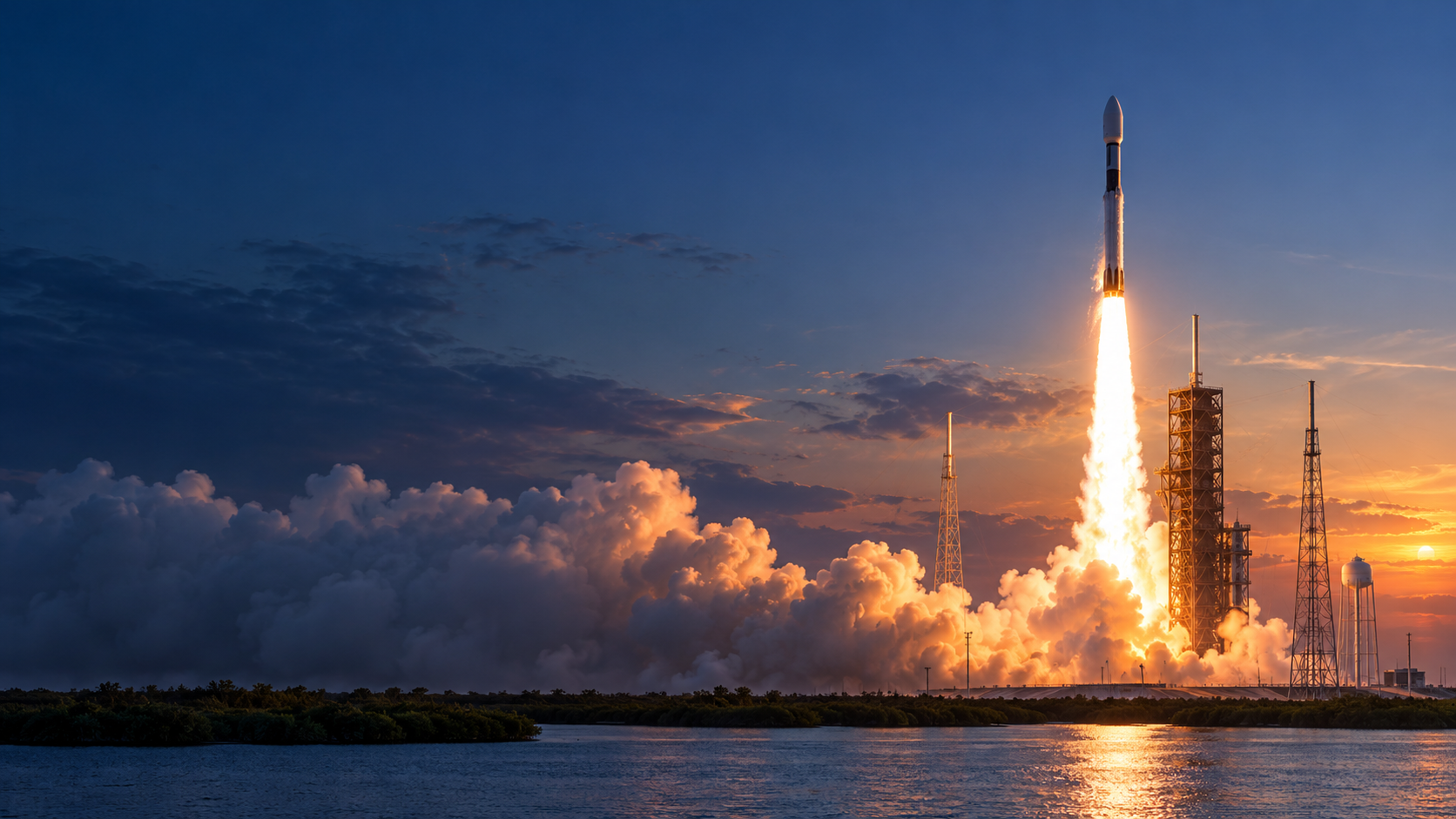
Photographers and skywatchers recently captured a glowing, jellyfish-shaped formation over Florida after a SpaceX launch. The unusual display was not a living creature, distant galaxy, or unidentified spacecraft. It was a rocket plume illuminated by sunlight high above Earth.
From the ground, the plume appeared as a luminous jellyfish with a bright upper body and diffuse trails extending beneath it. Photographs and videos quickly circulated online, where viewers compared the formation to a cosmic creature. Source 1
What Was the “Space Jellyfish”?
A Rocket Plume, Not an Astronomical Object
“Space jellyfish” is an informal nickname for a rocket plume that takes on a jellyfish-like appearance. It is not a scientific classification. The phrase describes the plume’s shape and glowing appearance rather than its physical identity.
Rocket exhaust expands as a vehicle climbs into thinner air. At high altitude, the plume may remain in direct sunlight even when darkness or twilight has reached observers on the ground. Sunlight scattered by exhaust gases and particles creates a bright, changing cloud.
The rocket itself may appear as a small point of light or may have moved outside the camera frame by the time observers notice the broad plume. Distance, perspective, and timing can make the formation appear detached from the vehicle.
Reports connected the photographed display to a SpaceX cargo mission. NASA-related coverage described a brightly illuminated, jellyfish-like plume rising through the atmosphere as sunlight struck it from above. Source 7
Why the Shape Resembles a Jellyfish
A typical rocket-plume “jellyfish” may include:
- A bright, rounded region near the top.
- A wider, hazy cloud surrounding the exhaust.
- Long, fading trails resembling tentacles.
The shape depends on altitude, trajectory, engine operation, exhaust composition, sunlight angle, atmospheric pressure, wind, and viewing position. Near the vehicle, exhaust remains narrow and concentrated. As it enters thinner air, it expands rapidly, spreads across a larger region, and becomes less defined.
Different engine stages or exhaust streams can add separate layers and trails. An observer looking along the flight path may see a different shape from someone viewing it from the side.
Where the Formation Was Seen
Reports described the jellyfish-shaped formation over Florida after a SpaceX launch. Because the plume rose high above the ground and spread through the upper atmosphere, it was visible beyond the immediate launch area. Source 9
The available reports support the broad explanation: a SpaceX launch produced a glowing plume, sunlight illuminated it at altitude, and photographers captured the resulting shape. They do not establish every technical detail, including the exact launch date, vehicle configuration, or viewing coordinates. Those details should be verified against official SpaceX or NASA records before publication.
How Rocket Exhaust Produces the Glow
Rocket engines burn propellant and expel combustion products through their nozzles. The gases initially form a concentrated stream. As the rocket ascends, atmospheric pressure falls, allowing the exhaust to expand into a broad, cloud-like plume.
Turbulence and density differences create brighter and darker regions. Engine throttling, stage separation, and changes in direction can alter the plume’s size and position. These factors explain why one launch may produce a compact glowing shape while another creates long, trailing forms.
Sunlight is the central reason a plume can glow after sunset or before sunrise. The ground may be dark while the upper plume remains above Earth’s shadow and receives direct sunlight. Light scatters from gases, particles, ice, and other material in the expanding exhaust.
The effect resembles high clouds remaining bright after sunset. A rocket plume differs because it forms rapidly, changes shape within minutes, and may occupy a large area of sky.
Atmospheric conditions also influence the display. Important factors include:
- Plume altitude and density.
- The Sun’s position relative to the horizon.
- Flight direction and viewing angle.
- Atmospheric temperature, pressure, and humidity.
- Wind and movement in the upper atmosphere.
- Cloud cover and local visibility.
A plume may appear white, blue, orange, pink, or violet. Twilight, low-angle sunlight, atmospheric scattering, and camera settings all affect its color. Long exposures and digital processing can make the display appear brighter and more colorful than it looked to the naked eye.
The SpaceX Launch Behind the Images
The reports connect the display to a SpaceX cargo mission. High-profile launches attract photographers because they are scheduled in advance, publicly tracked, and visible from multiple locations.
The most dramatic image may occur after liftoff. During the initial phase, the rocket appears as a bright point with a narrow trail. Later, as it climbs and the exhaust expands at high altitude, the plume becomes broader and more complex.
A high-altitude plume can rise above the horizon for observers far from the launch area. Visibility depends on trajectory, Earth’s curvature, weather, the observer’s position, and the angle between the plume and the Sun.
Earth.com described an otherworldly formation in the early morning sky and noted that it was recorded in photographs and video. Source 3
The available reports establish that a glowing, jellyfish-shaped formation appeared, that it was associated with a rocket plume, that sunlight illuminated it at high altitude, and that photographers and members of the public captured images and video. The exact mission should be confirmed through official records.
Why Photographs Made the Display Look Dramatic
Cameras can record faint light over several seconds, revealing edges and trailing structures that disappear during a brief glance. Long exposures also increase apparent brightness and may soften or stretch the plume’s outline.
Wide-angle lenses emphasize scale by placing the plume above buildings, shorelines, trees, or other foreground landmarks. This creates a strong sense of size, although framing does not establish the plume’s actual physical dimensions.
Post-processing can further change the appearance. Common adjustments include contrast, saturation, shadows, highlights, noise reduction, sharpening, white balance, and cropping. Captions should identify whether an image is unedited or processed.
How to Photograph a Rocket-Plume “Space Jellyfish”
Check official launch schedules because weather, technical issues, and range restrictions can cause delays. Review cloud cover, visibility, humidity, wind, and twilight timing. Clear skies near the horizon are especially useful.
Choose a safe location with an unobstructed view. Follow local rules, avoid restricted areas and private property, do not stand on active roads, and keep equipment away from traffic hazards. Never look directly at the Sun through a camera, telescope, binoculars, or other optical equipment.
A practical setup includes:
- A sturdy tripod.
- A wide-angle lens.
- Manual focus near infinity.
- RAW capture when available.
- Manual exposure.
- Moderate ISO.
- A shutter speed adjusted to the plume’s brightness.
- Spare batteries and sufficient storage.
Frame the expected flight path before launch and leave extra space around the plume. Capture a sequence showing the initial trail, expanding cloud, and fading structure. A continuous shooting mode or intervalometer can reduce camera movement and record rapid changes.
Is a “Space Jellyfish” Dangerous?
The optical display has a conventional explanation: expanding rocket exhaust, sunlight, atmospheric conditions, and viewing geometry. It is not evidence of a space creature or UFO.
Rocket launches still involve controlled operations, restricted zones, airspace controls, possible falling hardware, and official safety procedures. Viewers should follow instructions from launch authorities and local officials and remain outside restricted areas.
How It Differs From Other Sky Phenomena
Contrails
Contrails form behind aircraft, usually at lower altitudes, when water vapor condenses or freezes. They typically follow an aircraft’s route and appear as thin lines or broad streaks. Rocket plumes can expand more rapidly, glow after dark, and form irregular clouds.
Auroras
Auroras occur when charged particles interact with Earth’s upper atmosphere. They usually appear as broad curtains, arcs, bands, or shifting sheets. A rocket plume is localized, linked to a launch path, and often expands from a moving point.
Meteors
Meteors usually appear as brief streaks created when natural objects or space debris enter the atmosphere. A rocket plume can remain visible longer and evolve from a narrow trail into a large cloud.
Conclusion
The “space jellyfish” was a rocket plume that expanded through the upper atmosphere and became illuminated by sunlight. Its jellyfish-like form resulted from exhaust expansion, atmospheric conditions, trajectory, viewing angle, and camera perspective.
Reports linked the display over Florida to a SpaceX cargo mission, but the exact mission name and date should be verified against official records. Skywatchers interested in similar events should monitor launch schedules, weather forecasts, and twilight conditions while following all local safety rules.
FAQ
What is a “space jellyfish”?
It is an informal name for a rocket plume that expands into a jellyfish-like shape and glows when sunlight illuminates it high in the atmosphere.
Was it a real object in space?
No. It was a visual effect created by expanding rocket exhaust, sunlight, atmospheric conditions, and viewing angle.
Why can a rocket plume glow after dark?
The ground may be dark while the plume remains high enough to receive direct sunlight. The illuminated exhaust then appears bright against the darker sky.
Which launch created the photographed display?
The supplied reports connect it to a SpaceX cargo mission. The exact mission name and launch date require confirmation through official SpaceX or NASA records.
Can people see one from far away?
Yes. A high-altitude plume can spread across a wide area and remain visible far from the launch site when skies are clear and the viewing angle is favorable.
How can photographers capture one?
Use a tripod, wide-angle lens, manual focus, RAW capture when available, and a sequence of exposures. Check launch timing, weather, twilight conditions, and local safety restrictions before setting up.
Artikel Terkait
-
 Can Healthy Coral Help Bleached Neighbors Recover?
-
 SpaceX Launches Classified USSF-481 Payload
-
 Global Ice-Cliff Survey Tests Sea-Level Rise Theory
-
 SpaceX Cargo Dragon Delivers More Than 6,000 Pounds to ISS
-
 NASA-Backed Mission Targets a Mars Moon for Sample Return
-
 West Antarctica From Space: Ice, Glaciers, and Change