SpaceX Launch Creates ‘Space Jellyfish’ Over Louisiana
SpaceX Launch Creates “Space Jellyfish” Over Grand Isle, Louisiana
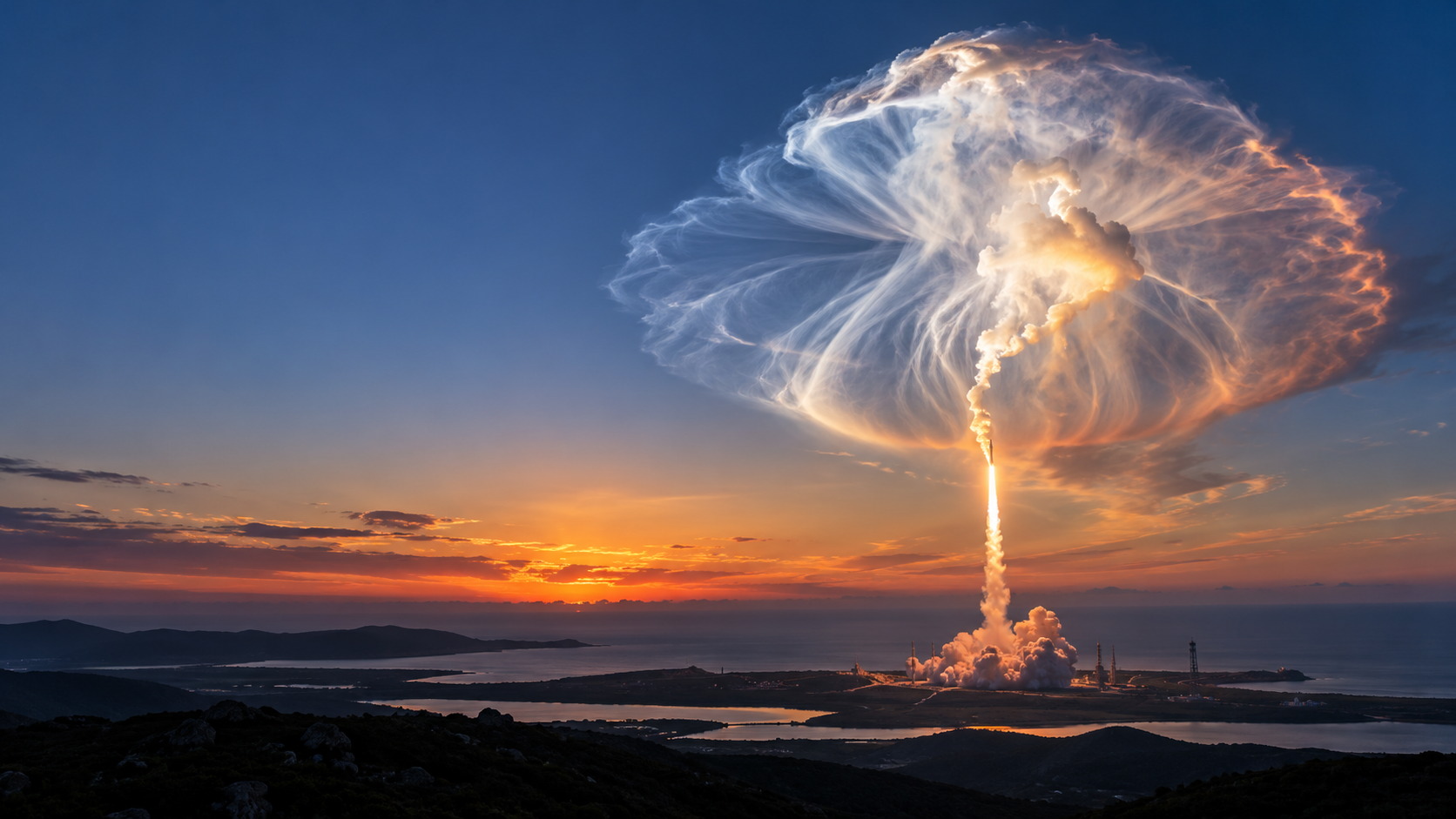
A strange, glowing formation appeared over Grand Isle in southeastern Louisiana after a SpaceX launch. Witnesses described it as a “space jellyfish,” inspired by its rounded upper section and trailing, tentacle-like structures.
The formation was not a literal jellyfish or a newly identified atmospheric object. Available reporting from KSLA connects the sighting with a SpaceX launch and indicates that an illuminated rocket exhaust plume was the likely explanation Source 1.
Rocket exhaust can look unusually large as it expands high above the ground. Sunlight may illuminate the plume after darkness reaches the surface, creating a pale, glowing, translucent effect. From a distant coastal viewpoint, that combination can make a routine launch resemble a large object drifting across the sky.
The available report confirms the sighting and its apparent connection to SpaceX. It does not establish the exact mission, launch vehicle, launch site, viewing time, altitude, trajectory, or weather conditions. Those details require confirmation through official launch records or additional authoritative reporting.
What Happened Over Grand Isle?
The Reported “Space Jellyfish” Effect
Observers saw a broad, luminous shape over or near Grand Isle. Its rounded top and trailing structures made it resemble a jellyfish suspended in the sky. “Space jellyfish” describes the appearance; it is not a scientific classification.
The formation may not have been directly above Grand Isle. A distant rocket plume can appear to hover over a particular community because of perspective. The viewer’s line of sight determines where the plume appears against the horizon, even when the launch vehicle is much farther away.
As a rocket climbs, its exhaust changes shape. The narrow column visible near the launch area can become a much broader cloud at higher altitude, where air pressure is lower. If sunlight reaches the expanding exhaust, the plume may appear bright against a darker sky.
The available KSLA-linked report establishes the connection between the Grand Isle sighting and a SpaceX launch, but it does not provide a complete event timeline or technical mission profile Source 1.
Where Is Grand Isle?
Grand Isle is a barrier-island community in southeastern Louisiana. Its coastal position provides an expansive horizon, with fewer tall buildings and elevated landforms than many inland locations.
That open setting may make distant launches easier to notice, but geography alone does not explain the sighting. Visibility depends on:
- The distance between Grand Isle and the launch path.
- The rocket’s direction of travel.
- Cloud cover and haze.
- The time of day.
- The viewer’s direction.
- Atmospheric clarity.
- The brightness and expansion of the exhaust plume.
Grand Isle should not be described as an official viewing location unless a launch authority confirms that status.
What Is Confirmed?
The available reporting supports three limited conclusions:
- A jellyfish-like formation was reported over Grand Isle.
- The sighting was associated with a SpaceX launch.
- The visual effect was likely caused by illuminated rocket exhaust.
The report does not establish the exact mission, rocket model, launch site, launch date, viewing time, altitude, or weather conditions. Those details should not be inferred from the shape alone.
Mission-specific confirmation should come from SpaceX, the Federal Aviation Administration, NASA when relevant, local authorities, or another reliable source with access to launch records. A social media caption may identify a mission, but that identification remains unverified until it matches official timing, location, and trajectory information.
Why Does a Rocket Plume Look Like a Jellyfish?
Rocket Exhaust Expands at High Altitude
Rocket engines release exhaust at extremely high speed. Near the launch vehicle, the exhaust can appear concentrated and directional. As the rocket rises, the surrounding atmosphere becomes thinner, allowing the exhaust to expand more freely.
That expansion can turn a narrow trail into a broad fan, cloud, halo, or rounded formation. From the ground, the plume may appear much larger than the rocket producing it.
The plume is not a solid object. It consists of exhaust gases and particles interacting with the surrounding atmosphere and available light. Turbulence, pressure changes, rocket motion, and changing illumination can reshape it within seconds.
Sunlight Can Illuminate the Exhaust
A rocket plume can remain visible after darkness reaches the ground. Higher portions of the atmosphere may still receive sunlight while the surface appears dark.
When sunlight reaches the expanding exhaust, gases and particles can scatter or reflect the light. The result may look like a glowing cloud suspended in space. This effect is especially striking during twilight, although the exact lighting conditions during the Grand Isle sighting have not been established by the supplied reporting.
The contrast between a dark lower sky and a sunlit upper plume can make the formation appear unusually bright. Depending on viewing conditions, it may look white, silver, blue, pink, orange, or purple.
Why Does It Have “Tentacles”?
The trailing structures may result from separated exhaust streams, turbulence, shifting gas density, or uneven lighting across the plume. As the rocket moves, exhaust is left behind and expands through different atmospheric layers.
A viewer may interpret these changing strands as tentacles, particularly when a rounded upper section appears above several thinner trails. A photograph or video can intensify the effect through camera exposure, digital zoom, image sharpening, and contrast adjustments.
The shape can also change rapidly. A frame captured one second later may show a wider or less recognizable plume.
Why Can the Colors Look Unusual?
Rocket-plume colors depend on exhaust chemistry, sunlight angle, atmospheric scattering, clouds, haze, and camera settings. The same plume may look different to the naked eye and in a smartphone recording.
Color alone cannot identify the rocket, engine, or mission. Official launch imagery and mission documentation provide a more reliable basis for technical comparisons than a single photograph.
Why Could People See a SpaceX Launch From Louisiana?
Large rockets can be visible across a broad region when their trajectory, brightness, altitude, and atmospheric conditions align. The vehicle may appear as a moving point of light, while its expanding exhaust becomes the dominant feature.
Seeing a plume from Louisiana does not necessarily mean the rocket launched nearby. A vehicle can travel a considerable distance before its exhaust reaches the altitude and lighting conditions that produce the jellyfish-like effect.
Grand Isle’s coastal setting may provide a broad view toward the horizon, but clouds and haze can still block the display. The rocket must also travel through a favorable part of the sky, and the viewing direction matters.
The supplied Weather Channel source is a general weather-information entry dated January 14, 2016. It does not establish conditions during the Grand Isle sighting and should not be used as evidence of event-specific visibility Source 3.
Exact visibility conditions would require archived observations from a nearby weather station, local airport, or National Weather Service office.
Is a “Space Jellyfish” Dangerous?
A rocket plume seen from the ground is a visual result of a launch and upper-atmosphere conditions. The image itself does not indicate an explosion, unidentified aircraft, or dangerous weather event.
However, a visual description cannot determine whether a particular launch experienced a technical problem. Official launch agencies and emergency authorities provide the relevant information when an anomaly occurs. Observers should not make safety conclusions based solely on a photograph or video.
Viewers who see an unusual launch effect should check:
- SpaceX announcements and mission updates.
- Federal Aviation Administration commercial spaceflight information.
- NASA notices when NASA is involved.
- Local emergency management agencies.
- National Weather Service offices for weather-related concerns.
Social media posts can help establish where and when people saw the event, but captions that name a mission or claim an explosion require independent verification.
How to Distinguish a Rocket Plume From Other Sky Phenomena
Rocket Launches
Common indicators include:
- A bright point moving rapidly across the sky.
- A spreading plume behind or around the vehicle.
- A fan, halo, cloud, or jellyfish-like shape.
- Visibility across a wide geographic area.
- A close match with a documented launch time and trajectory.
The strongest identification comes from matching the sighting with official launch records. Shape alone is insufficient because clouds and other atmospheric effects can create similar forms.
Auroras
Auroras often appear as curtains, ribbons, arcs, or shifting bands of light. They generally remain associated with the night sky rather than moving quickly across it like a launch plume. Geographic forecasts and space-weather reports can help determine whether auroral activity was likely.
Meteors and Fireballs
Meteors usually appear as brief streaks or flashes. A bright fireball can be dramatic, but it normally lasts much less time than a slowly expanding rocket plume. A meteor also does not usually create a large, persistent, jellyfish-shaped structure.
Clouds and Atmospheric Optics
Clouds can resemble unusual objects when illuminated from below or above. Light pillars, halos, and other atmospheric optics can also produce vertical or glowing structures.
These phenomena generally remain fixed relative to the landscape or change more slowly than a moving rocket plume. Comparing videos from different locations and checking launch records can help distinguish them.
What the Available Sources Establish
The KSLA-linked report supports the basic account: a space-jellyfish-like formation was seen over Grand Isle, and the phenomenon was associated with a SpaceX launch Source 1.
That report allows the plume explanation to be presented as likely, not as a fully documented technical finding. It does not provide enough evidence to identify every detail of the launch.
The supplied entries do not establish the launch date, vehicle type, mission name, launch location, viewing conditions, altitude, or exact cause of the plume’s shape. The Weather Channel entry is dated January 14, 2016 and does not establish event-specific weather conditions Source 3.
Researchers or reporters seeking exact visibility conditions should consult archived local observations from the relevant date.
How Social Media Can Amplify the Effect
A phone camera can alter the appearance of a rocket plume. Long exposure may brighten faint exhaust and make it appear larger. Digital zoom can reduce detail while emphasizing the central glow. Automatic contrast and color processing can create stronger blue, pink, orange, or purple tones.
A photograph can also freeze one stage of plume expansion, making the formation appear more stable than it was. Comparing videos from different locations provides useful context because differences in angle, size, and brightness may reflect distance, camera settings, and local atmospheric conditions.
“Space jellyfish” is a memorable description, but it is not a formal scientific term. Readers should separate three questions:
- What did witnesses observe?
- What did the image resemble?
- What do launch records confirm?
The first concerns eyewitness experience, the second concerns visual description, and the third requires authoritative evidence.
How to Confirm the Exact SpaceX Mission
Compare the reported sighting with:
- The launch date.
- The official launch window.
- The rocket’s trajectory.
- The vehicle type.
- The mission destination.
- The time and direction of the visible plume.
SpaceX launch announcements and mission archives are useful starting points. The visual shape should not be the sole basis for identification because different launches can produce similar plume effects.
The Federal Aviation Administration may provide commercial spaceflight information, while NASA may publish notices for missions involving its spacecraft or facilities. Local news outlets in Louisiana, Florida, and other locations along a possible viewing corridor may provide eyewitness timing and additional imagery.
Eyewitness posts are supplementary evidence. They become more useful when several independent observers report the same time, direction, and movement. Official records remain necessary for firm mission identification.
Conclusion
The “space jellyfish” over Grand Isle was likely an illuminated SpaceX rocket plume. High-altitude exhaust can expand into a broad, cloud-like formation, while sunlight can illuminate it against a darker sky. From a coastal location with an open horizon, the effect can become a striking regional spectacle.
“Space jellyfish” describes the appearance, not a new atmospheric category or unidentified creature. The available KSLA-linked reporting confirms the reported sighting and its connection to a SpaceX launch, but it does not establish the exact mission, rocket, launch time, trajectory, or weather conditions Source 1.
For mission-specific confirmation, viewers should compare the sighting with SpaceX announcements, FAA records, NASA information when applicable, local news coverage, and archived weather observations. This process separates a compelling visual nickname from verified launch data.
Frequently Asked Questions
What was the “space jellyfish” seen over Grand Isle?
It was a jellyfish-shaped glow reported over Grand Isle and likely produced by the illuminated exhaust plume of a SpaceX rocket. The nickname describes the plume’s appearance rather than a separate object.
Was it a real jellyfish or an unidentified flying object?
No evidence in the available reporting identifies it as either. The reported explanation is a rocket plume associated with a SpaceX launch. Exact mission details require confirmation through official launch records.
Why did the SpaceX plume look so large?
Rocket exhaust expands rapidly at high altitude, where air pressure is lower. Sunlight can illuminate the expanding plume after darkness reaches the ground, making it appear broad, bright, and translucent.
Why could people see the plume from Grand Isle?
A rocket plume can be visible across a large region. Grand Isle’s coastal setting may provide an unobstructed horizon, while clouds, haze, humidity, and atmospheric clarity determine visibility.
Can rocket launches create colorful shapes in the sky?
Yes. Exhaust, sunlight, atmospheric scattering, cloud conditions, and camera exposure can produce white, blue, orange, pink, or purple tones. Color alone cannot identify the rocket or mission.
How can viewers confirm what they saw?
Compare the sighting’s time and direction with SpaceX launch announcements, FAA records, NASA information when applicable, local news coverage, and archived weather observations. Treat viral social media captions as unverified until they match authoritative records.
Artikel Terkait
-
 Green White Dwarf May Reveal a Destroyed Planetary System
-
 Thwaites Glacier Melting More Aggressively Than Expected
-
 Artemis II Astronauts Retire From Spaceflight: What Comes Next
-
 How Early Humans Survived Climate Chaos in America
-
 Can Healthy Coral Help Bleached Neighbors Recover?
-
 What Created the Rocket-Plume “Space Jellyfish”?