49ers Hold Off Commanders 23–17 on Monday Night Football
49ers Hold Off Commanders 23–17 on Monday Night Football
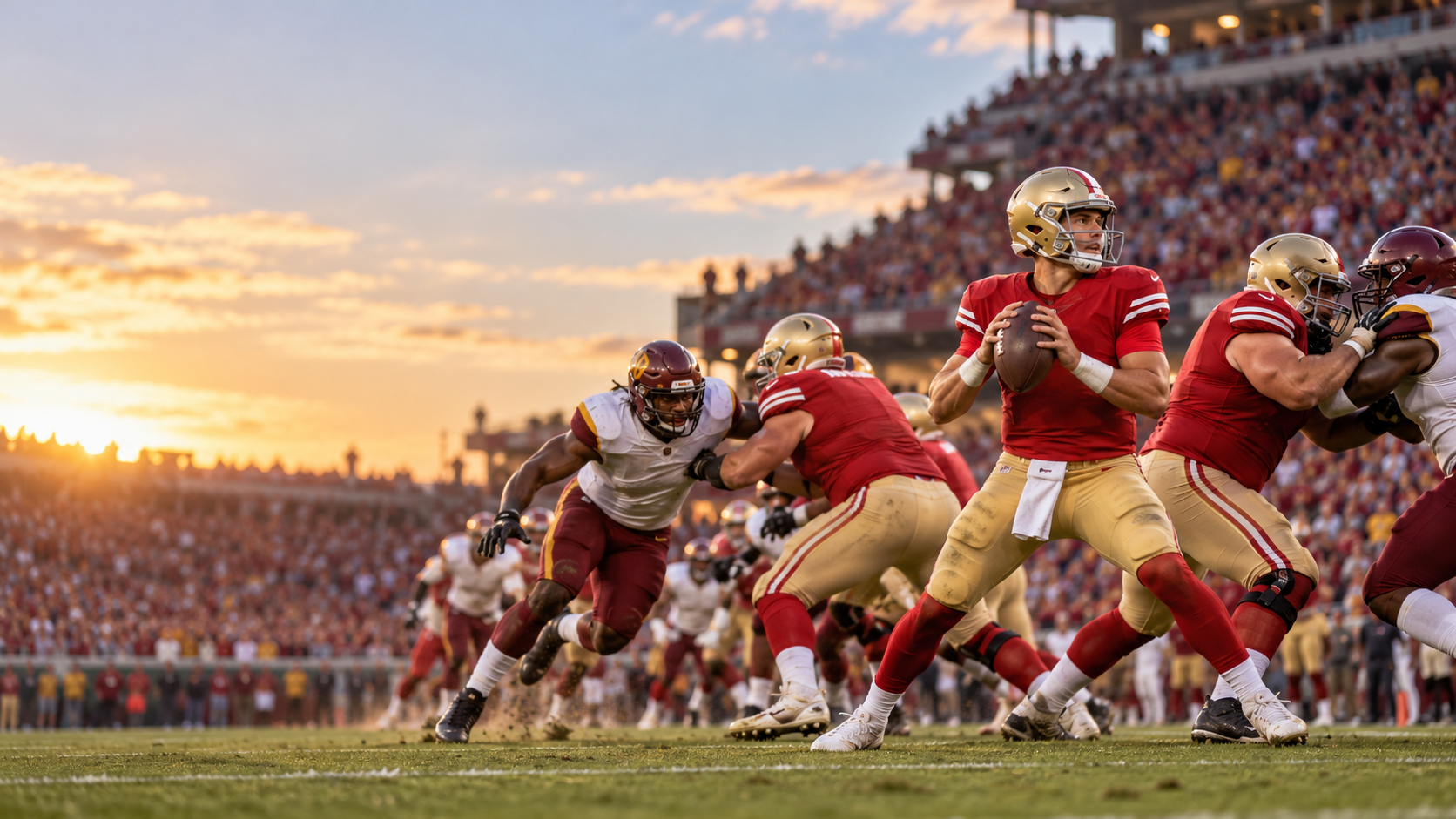
The San Francisco 49ers defeated the Washington Commanders 23–17 on Monday Night Football, preserving their unbeaten record after Washington mounted a late comeback attempt.
San Francisco built an early advantage and protected a six-point lead through the closing stages. The Commanders stayed within striking distance, but the 49ers prevented the rally from producing a tie or a Washington victory.
According to the supplied Mercury News coverage, the win moved San Francisco to 6–0. Source 9
Two separate summaries describe the same sequence: a 23–17 San Francisco win, decided by a Washington push that fell short. Source 1 Source 5
San Francisco Survives Washington’s Late Push
The 23–17 final score reflects a competitive game rather than a dominant finish. San Francisco created enough separation to control the result, but Washington remained close enough to make the final stages tense.
The available reports confirm the final score, the late comeback attempt, and San Francisco’s 6–0 record. They do not provide a verified play-by-play account, quarter-by-quarter scoring breakdown, player statistics, injury report, venue, or attendance information. Those details should not be added without an official box score or detailed game report.
Read together, the summaries support a narrow set of facts: the two teams, the 23–17 score, the late Washington rally, and San Francisco’s 6–0 record. Source 5 Source 9 Everything else — which players scored, when the lead changed hands, how many plays the closing drive consumed — lives in a box score the supplied material does not contain. That boundary is worth stating plainly, because recaps of close games tend to fill gaps with plausible-sounding detail that no source supports.
The 49ers Build a Winning Advantage
San Francisco scored 23 points, which proved sufficient to defeat Washington. The final score indicates that the 49ers established the advantage necessary to withstand the Commanders’ late pressure.
The supplied sources do not identify the players responsible for the scoring, explain how the points were distributed by quarter, or detail the drives that produced the lead. The confirmed conclusion is that San Francisco created a cushion and protected it when the game became close.
One point follows from the score itself rather than from reporting: 23 points cannot come from a single play under standard scoring rules, so the total reflects more than one scoring sequence. How those sequences were assembled — touchdowns against field goals, early against late — is inference the sources do not license.
How the Six-Point Margin Shapes the Finish
The arithmetic of the scoreboard explains why the closing stages mattered. A six-point lead means a Washington touchdown with a successful extra point would have produced a one-point lead, and a touchdown plus a two-point conversion would have tied the game. A field goal would have narrowed the gap without erasing it.
That structure keeps a game alive until the trailing team’s possessions run out. It also explains the emphasis on late-game execution in every account of the result: the 49ers were defending a margin that a single drive could overturn, and they did not let it happen. Source 5
What the score cannot tell you is how much time remained when Washington last had the ball, or whether the Commanders reached scoring range on their final series. Those details are absent from the supplied summaries.
Washington Makes the Finish Uncomfortable
Washington’s late rally defined the closing stages. The Commanders continued competing after falling behind and created enough pressure to keep the outcome uncertain.
The rally did not change the result. San Francisco prevented Washington from turning its late momentum into a tie or a lead and secured the six-point victory. Source 5
The reporting draws a line between a comeback attempt and a completed comeback. Washington applied pressure; San Francisco absorbed it. The summaries do not specify the size of the deficit Washington faced late, how many points the rally produced, or whether the Commanders held possession with a chance to tie. A reader who wants those specifics needs the play-by-play, not the recap.
San Francisco Finishes the Job
The 49ers did not win by a runaway margin, but they produced the result they needed. Protecting a narrow lead placed greater importance on late-game execution and composure.
The victory moved San Francisco to 6–0, extending its perfect start. Source 9
Finishing a one-score game reads like a repeatable skill but is hard to measure from a result alone. The supplied coverage gives the outcome — a held lead and an unbeaten record — without the inputs that would explain it, such as third-down conversions, red-zone results, or turnover margin. Treat the composure framing as a description of what happened on the scoreboard, not a proven cause of it.
Notes From an ‘Unusual’ Victory
Niners Wire published notes and observations from the game on October 20, 2026, describing the 49ers’ win over Washington as unusual. Source 7
The supplied summary carries the characterization and the publication date but not the observations themselves. The word choice signals that the outlet saw the game as departing from a routine win; what produced that judgment sits outside this article’s verified scope. Readers who want the detail should go to the original notes column rather than to a secondary recap.
What the Result Means
The 49ers Remain Unbeaten
At 6–0, San Francisco continues to set the standard for its season. An undefeated record brings increased expectations, and close games can reveal how well a team responds to pressure.
This result does not establish a specific weakness or identify individual performances because detailed statistics and injury information were not supplied. It does show that the 49ers can survive a competitive finish and maintain their perfect record.
A six-point win counts identically to a blowout in the standings. The record is the durable fact; the margin is context. What the 6–0 start does not yet show is how the team will handle the remainder of its schedule, which the supplied material does not describe.
Why Close Wins Resist Simple Conclusions
Margin of victory bundles three things together: opponent quality, game-to-game variance, and execution under pressure. A six-point win over a team that rallied late could indicate resilience, or it could indicate a lead that should have been larger. Separating those readings requires data the summaries do not provide.
The honest assessment is therefore limited but not empty. San Francisco is 6–0 and has now won a game in which the opponent had a late chance to change the result. Source 9 Whether that pattern repeats is a question for the next game, not for this recap.
Washington Shows Competitiveness
The Commanders lost, but their late rally offered a positive element. Washington stayed within one score of an unbeaten opponent and forced San Francisco to protect its lead until the end.
The next challenge is turning that competitiveness into a completed comeback. The 23–17 loss leaves Washington with a clear late-game question: how can it sustain pressure long enough to tie or win?
Competitiveness against an unbeaten opponent is a real signal and an incomplete one. The summaries do not give Washington’s overall record, so the loss cannot be placed in the context of its season. What they do establish is that the Commanders were still playing for the result in the closing stages rather than out of it.
What Turning Pressure Into Points Requires
Completing a rally from a one-score deficit takes two things in sequence: converting late possessions into points, then preventing the opponent from answering. Washington managed the first part of that job well enough to keep the game undecided; the second part belonged to San Francisco, which held the lead.
Whether Washington had the ball with a chance to tie is not stated in the supplied reports, so the final sequence should not be reconstructed from the score alone. The confirmed version is narrower and still meaningful: the rally happened, and it came up short.
Key Takeaways
- Final score: San Francisco 49ers 23, Washington Commanders 17.
- Winner: San Francisco 49ers.
- Event: Monday Night Football.
- Confirmed storyline: San Francisco held off Washington’s late comeback attempt.
- San Francisco’s record: 6–0, according to the supplied Mercury News summary.
- Coverage date: Niners Wire published notes and observations on the game on October 20, 2026, calling the win unusual. Source 7
- Live coverage: the Mercury News ran live updates on the game. Source 9
- Unverified details: Venue, date, attendance, quarter-by-quarter scoring, player statistics, injuries, turnovers, time of possession, and upcoming opponents.
FAQ
Who won the Monday Night Football game between the 49ers and Commanders?
The San Francisco 49ers defeated the Washington Commanders 23–17. Source 1
Did the Commanders make a late comeback attempt?
Yes. Washington mounted a late rally, but San Francisco held on and preserved its six-point victory.
What was the 49ers’ record after the win?
The supplied Mercury News summary states that San Francisco improved to 6–0.
Was the game close?
Yes. The 49ers won by six points, and Washington’s late comeback attempt kept the outcome in doubt during the closing stages.
Why was the win described as unusual?
Niners Wire characterized the victory as unusual in notes and observations published October 20, 2026. Source 7 The supplied summary does not list the specific observations behind that description.
Do the sources include a box score?
No. Quarter-by-quarter scoring, individual statistics, turnovers, time of possession, injuries, venue, and attendance are not in the supplied material, so they are omitted rather than estimated.
What was the main takeaway?
San Francisco remained unbeaten by scoring 23 points and resisting Washington’s late push. The result also showed that the 49ers needed disciplined late-game execution to protect their lead.