What Ended the Cosmic Dark Age?
What Ended the Cosmic Dark Age?
The universe was not always filled with stars, galaxies, and glowing clouds of gas. For hundreds of millions of years after the Big Bang, it contained matter but no known luminous objects. Hydrogen filled space, dark matter gathered into growing structures, and the cosmos remained largely unlit.
This period is known as the Cosmic Dark Age. It began after the universe became transparent and neutral, roughly 380,000 years after the Big Bang, and ended when the first stars and galaxies began flooding space with light.
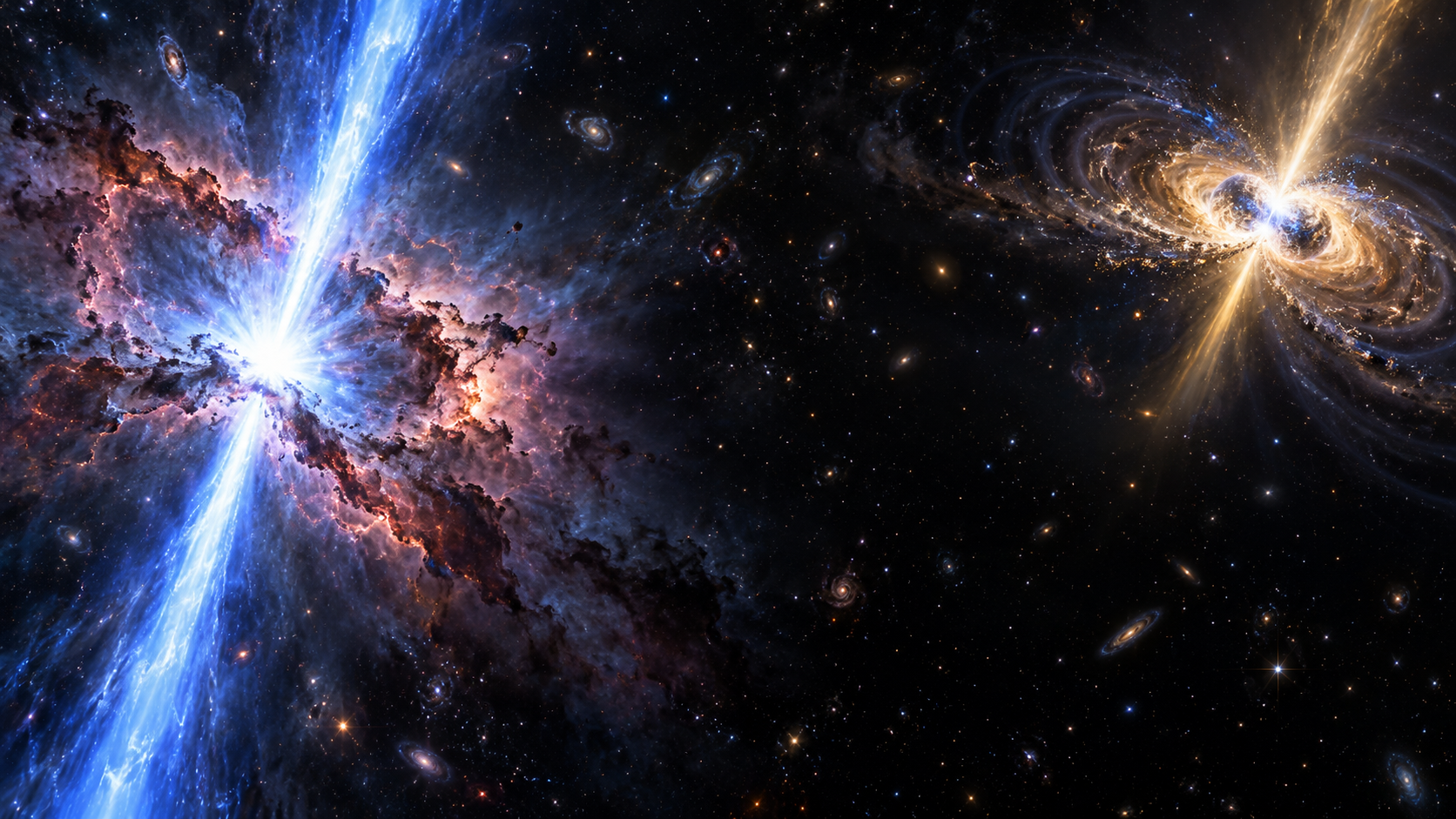
The leading explanation is cosmic reionization. Early stars produced ultraviolet radiation energetic enough to strip electrons from hydrogen atoms. As more stars formed inside early galaxies, their radiation created expanding bubbles of ionized gas. Eventually, those bubbles merged, leaving most of the intergalactic medium ionized.
Astronomers know that this transformation occurred. They are still determining which objects supplied most of the radiation, how quickly reionization progressed, and when the first stars appeared. Observations from the James Webb Space Telescope (JWST), measurements of the cosmic microwave background (CMB), and studies of distant quasars are narrowing the possibilities.
The Cosmic Dark Age probably ended through a gradual cosmic awakening rather than one sudden event. The first stars may have started the process, while early galaxies likely completed it.
What Was the Cosmic Dark Age?
After the Cosmic Microwave Background
The early universe began as a hot, dense mixture of particles and radiation. As it expanded and cooled, protons and electrons combined to form neutral hydrogen, approximately 380,000 years after the Big Bang.
Before this transition, free electrons scattered light so efficiently that the universe was opaque. Once electrons joined atomic nuclei, light could travel more freely. The radiation released during this transition is observed today as the cosmic microwave background, or CMB.
The CMB shows the universe at an early stage, but it does not show the first stars. After the CMB was released, the universe became transparent yet remained almost completely dark. Hydrogen and helium gas filled space, while dark matter provided the gravitational framework that helped matter collect into denser regions.
The universe therefore contained the ingredients needed to form stars, but no ordinary visible-light sources had emerged. Neutral hydrogen also absorbed particular wavelengths of radiation, making the early cosmos difficult to observe with conventional telescopes.
Why It Was Called a “Dark Age”
“Dark” does not mean the universe was empty. It means that stars and galaxies had not yet formed in substantial numbers.
Dark matter began clumping under gravity. Gas fell into growing dark matter halos, becoming denser and colder. Eventually, some clouds collapsed far enough to ignite nuclear fusion. These first stars became the first major sources of light after the CMB.
The exact length of the Cosmic Dark Age remains uncertain. Astronomers have not yet confirmed an individual Population III star, the name given to the expected first generation of stars. Instead, they study increasingly distant galaxies and search for indirect evidence of their stellar populations.
The Cosmic Dark Age is distinct from the modern universe’s dark components. Dark energy is associated with the accelerating expansion of the universe, while dark matter helped build cosmic structure. The Cosmic Dark Age concerns the lack of early luminous objects.
What Ended the Cosmic Dark Age?
The First Stars
The first stars were probably Population III stars. Unlike later generations, they formed almost entirely from hydrogen and helium because heavier elements had not yet been produced by earlier stars.
These stars may have been much more massive than the Sun. Their lack of heavy elements could have allowed them to remain exceptionally hot, bright, and short-lived. Their intense ultraviolet radiation could ionize hydrogen in the gas surrounding each star, creating small regions of ionized gas within an otherwise neutral universe.
Population III stars may also have ended their lives as powerful supernovae. These explosions would have scattered newly formed heavier elements into space, enriching the gas from which later stars and galaxies formed.
Individual stars could not ionize the entire universe. Their lifetimes were brief, and much of their radiation may have been absorbed by nearby gas. The larger transformation required many stars forming repeatedly across numerous early galaxies.
Early Galaxies
Early galaxies probably played the central role in expanding reionization. Each galaxy could contain thousands or millions of stars, producing far more ultraviolet radiation than an isolated star.
Some early galaxies may have been small by modern standards but numerous. Their combined radiation could create larger ionized regions. As more galaxies formed, these bubbles expanded and began to overlap.
Supernova explosions and stellar winds may also have helped ultraviolet radiation escape. Dense gas inside a galaxy can absorb ionizing photons before they reach intergalactic space. Violent stellar activity may have opened channels through which some radiation could pass.
The leading picture does not identify one single event as the end of the Dark Age. The first stars probably initiated the process, while populations of stars inside early galaxies sustained and expanded it.
Cosmic Reionization
Cosmic reionization describes the period when ultraviolet photons stripped electrons from neutral hydrogen atoms throughout much of the universe.
The process unfolded in stages:
- The first stars formed in dense regions.
- Their ultraviolet radiation created small ionized bubbles.
- Early galaxies produced additional ionizing radiation.
- The bubbles expanded and merged.
- Most of the intergalactic medium became ionized.
Reionization marks the end of the Cosmic Dark Age because the universe became dominated by luminous sources and ionized gas. Astronomers generally place it within the universe’s first billion years, although its precise beginning, duration, and completion remain uncertain.
How Reionization Unfolded
A Patchy, Uneven Process
Reionization did not occur everywhere simultaneously. The earliest stars formed in the densest regions, where dark matter halos and gas had gathered most efficiently. Regions containing more matter and more galaxies probably reionized first, while less dense areas remained neutral for longer.
This patchy process makes reionization difficult to reconstruct. A distant object may show conditions along one line of sight, while another region was at a different stage of the transition.
The Escape-Fraction Problem
One of the most important uncertainties is the escape fraction: the proportion of ionizing photons that leaves a galaxy and enters intergalactic space.
Gas and dust can absorb much of the ultraviolet radiation produced inside a galaxy. If only a small fraction escapes, a galaxy may contribute little to large-scale reionization. If the escape fraction was higher in early galaxies, even faint systems could have had a major effect.
Supernovae, stellar winds, irregular gas distributions, and galaxy mergers may all have influenced the escape fraction. If early galaxies released radiation efficiently, a population of faint galaxies may explain the transformation. If the escape fraction was low, more powerful sources or an additional contribution from black holes may be necessary.
Possible Contributions from Black Holes
Quasars and active galactic nuclei emit powerful ultraviolet and X-ray radiation. They are powered by matter falling toward massive black holes and could have ionized large volumes of gas.
Their limitation is abundance. Quasars appear to have been less common during the earliest stages of the universe than ordinary star-forming galaxies. Current evidence therefore does not support quasars as the sole cause of reionization.
Black holes may still have contributed in particular environments. The most likely explanation involves several sources: first stars lit the earliest regions, early galaxies drove most of the large-scale transformation, and black holes contributed in some settings.
Evidence That Reionization Happened
The Cosmic Microwave Background
The CMB provides indirect evidence of reionization. When hydrogen became ionized, newly freed electrons scattered some microwave background photons.
Measurements of this scattering help estimate when reionization began and whether it occurred over a short or extended period. CMB polarization is especially useful because scattering can leave a characteristic imprint on the radiation’s polarization pattern.
The CMB supplies a broad timeline, but it does not identify every object that produced the necessary photons.
Quasar Spectra
Distant quasars act as bright background lamps. Their light passes through hydrogen gas between the quasar and Earth. Neutral hydrogen absorbs specific ultraviolet wavelengths, producing a distinctive loss of transmitted light known as the Gunn–Peterson trough.
A strong trough indicates that substantial neutral hydrogen remained in the early universe. Changes in this absorption feature across cosmic time help astronomers determine when reionization was nearing completion.
Quasar spectra provide detailed information, but quasars are rare. Each one probes a particular line of sight, and different sight lines can pass through regions that reionized at different times.
The 21-Centimeter Signal
Neutral hydrogen emits radiation at a wavelength of 21 centimeters. This signal could become one of the most powerful tools for studying the Cosmic Dark Age and reionization.
A sufficiently sensitive survey could map neutral hydrogen across large regions of the early universe. It could show how ionized bubbles grew, where the first galaxies formed, and how radiation changed the surrounding gas.
The challenge is extreme: the cosmic 21-centimeter signal is faint, while radio transmissions from Earth and human technology can be millions of times stronger. Instruments must separate the ancient signal from this foreground contamination.
Future radio observatories in space, including proposed facilities on the far side of the Moon, could provide a quieter environment. These observatories remain proposals rather than operating facilities. Source 9
Why JWST Matters
JWST observes infrared light, which is essential for studying the early universe. As light travels across expanding space, its wavelength becomes stretched, shifting ancient ultraviolet and visible light into infrared wavelengths.
JWST can measure the distances and redshifts of early galaxies. Its instruments also provide information about stellar populations, star-formation rates, gas composition, and possible signs of active black holes.
Finding an early galaxy does not prove that it caused reionization. Astronomers must estimate how many similar galaxies existed, how much ultraviolet radiation their stars produced, and how much escaped into space.
Even so, JWST has expanded the known population of early galaxies and is testing whether older models underestimated the number or brightness of galaxies during the first billion years. Source 1
Astronomers are using JWST to determine how many galaxies existed during reionization, how efficiently their stars produced ultraviolet radiation, what fraction of ionizing photons escaped, how chemically primitive their stars were, and whether early black holes contributed substantially.
JWST cannot provide one definitive image of the moment the Dark Age ended. It observes individual galaxies and populations at different stages, helping researchers reconstruct a process that unfolded over hundreds of millions of years.
Can Astronomers See the Beginning of Time?
Looking farther away means looking further back in time because light travels at a finite speed. The earliest electromagnetic signal visible to astronomers is the CMB, released when the universe became transparent.
Ordinary light cannot show the opaque period before that release. Photons from earlier times were repeatedly scattered by free electrons and could not travel directly to modern telescopes.
Earlier information may come from primordial gravitational waves, relic neutrinos, and the 21-centimeter signal from neutral hydrogen. These signals could reveal conditions unavailable through visible or infrared light, but they would provide indirect evidence rather than a conventional image of the universe’s earliest instant. Source 3
What Astronomers Still Do Not Know
Major unanswered questions include:
- When did the first stars form?
- How massive and chemically primitive were they?
- How many small galaxies existed during reionization?
- How much ionizing radiation escaped each galaxy?
- When did reionization begin and end?
- Did different regions reionize at substantially different times?
- How important were early black holes?
Infrared observations reveal early galaxies. Quasar absorption studies track neutral hydrogen. CMB polarization measurements constrain the broad timeline. Future 21-centimeter surveys could map the transition directly.
“Closer than ever” means that models are becoming more constrained, not that every uncertainty has been resolved. The central explanation is strong, but its precise details remain under investigation. Source 5
Conclusion: A Gradual Cosmic Awakening
The Cosmic Dark Age most likely ended when the first stars and galaxies produced enough ultraviolet radiation to reionize the universe.
The transition was gradual and uneven. Population III stars probably created the earliest ionized bubbles, while early galaxies supplied the sustained radiation needed to expand and merge those regions across cosmic space. Quasars and black holes may have contributed, but they are not considered the primary cause.
CMB measurements establish a broad timeline. Quasar spectra reveal how neutral hydrogen changed. JWST identifies early galaxies and measures their properties. Future radio observatories may map the neutral hydrogen that filled the universe before reionization.
Understanding this transformation explains how the first structures changed the cosmos and connects the earliest stars to the galaxies, gas clouds, and cosmic web observed today.
Frequently Asked Questions
What was the Cosmic Dark Age?
It was the period after the universe became filled with neutral hydrogen but before the first stars and galaxies produced significant light.
What ended the Cosmic Dark Age?
The first stars and galaxies most likely ended it. Their ultraviolet radiation ionized neutral hydrogen during cosmic reionization.
When did cosmic reionization happen?
Reionization occurred during the universe’s first billion years, although its precise beginning and end remain uncertain.
Did the first stars or the first galaxies cause reionization?
Both probably played roles. The first stars created the earliest ionized regions, while early galaxies produced and sustained much larger amounts of ionizing radiation.
Could quasars have ended the Cosmic Dark Age?
Quasars and active black holes may have contributed, but they were probably too rare during the earliest periods to explain reionization alone.
Can telescopes observe the first stars directly?
Astronomers have not yet confirmed an individual Population III star. JWST can detect early galaxies and search for chemical and spectral clues associated with their first stellar populations.