Japan’s Phobos Sample-Return Mission: What to Know
Japan’s Phobos Sample-Return Mission: What to Know
Japan is scheduled to launch a robotic mission to Phobos, one of Mars’s two moons, on October 19, 2026. Its long-term objective is to collect material from Phobos and return it to Earth for detailed laboratory analysis. Source 1
The launch is only the mission’s opening event. If the spacecraft reaches Mars, operates near Phobos, collects a scientifically useful sample, and returns it safely, researchers could gain new evidence about the moon’s origin, the history of Mars, and the early Solar System.
The supplied reports identify October 19, 2026, as the scheduled launch date. They do not verify the launch time, launch site, rocket, mission duration, sampling location, or official livestream URL. Those details should be confirmed through JAXA or the launch provider before publication. Yahoo Tech is reported to be providing live launch coverage. Source 3
Mission Overview
Japan’s publicly documented Phobos sample-return project is the Martian Moons eXploration mission, commonly known as MMX. JAXA describes MMX as a mission designed to study Phobos and return samples to Earth. JAXA
Unlike a spacecraft that only analyzes a world with onboard instruments, a sample-return mission brings physical material back to Earth. Researchers can then study it with large, sensitive laboratory equipment, repeat measurements, compare results across facilities, and preserve portions for future research.
What Readers Need to Know Before Watching
- Mission: Japan’s robotic Phobos sample-return mission.
- Destination: Phobos, the larger and closer of Mars’s two moons.
- Objective: Collect Phobos material and return it to Earth.
- Reported launch date: October 19, 2026.
- Live coverage: Yahoo Tech is reported to offer live launch coverage. Source 3
- Verification: Confirm the launch time, time zone, rocket, launch site, and official broadcast through JAXA or the launch provider.
“Scheduled to launch” is the appropriate description before confirmed liftoff. “Launch underway” applies during the countdown or ascent. “Liftoff” applies once the rocket leaves the launch pad. “Successfully deployed” requires confirmation that the spacecraft separated from its launch vehicle and entered its expected early mission condition.
What Is Phobos?
Phobos is Mars’s larger and innermost natural satellite. It has an irregular shape, a heavily cratered surface, and extremely weak gravity. Dust, loose rocks, slopes, and uneven terrain could complicate spacecraft contact and sampling.
The moon’s origin remains an important scientific question. Some evidence suggests that Phobos may contain material related to Mars, while other characteristics have led researchers to compare it with asteroid-like bodies. Impacts may also have transported Martian material into orbit around the planet.
A sample-return mission may not resolve every question. Its findings will depend on where the spacecraft samples, how much material it collects, and whether that material represents a broad or limited part of Phobos.
Why Sample Phobos Instead of Mars?
Mars is difficult to land on, explore, and launch away from. Phobos is smaller and has much weaker gravity, which may make a sample-return architecture more manageable than collecting material directly from Mars and launching it from the Martian surface.
Phobos may contain several scientifically valuable types of material:
- Native material linked to the moon’s formation.
- Martian rocks ejected by major impacts.
- Dust deposited from the Martian environment.
- Surface particles altered by solar radiation and micrometeorite impacts.
Earth-based analysis can distinguish among these possibilities more effectively than a limited set of spacecraft instruments. Scientists may study minerals, chemistry, isotopes, microscopic structure, age, and radiation exposure.
The quality of the results will depend on sample diversity. A small quantity from one location may answer some questions while leaving others unresolved. A carefully documented sample from a scientifically selected region could provide stronger evidence about Phobos.
How a Phobos Sample-Return Mission Works
The following sequence describes how a mission of this type generally operates. Specific hardware, timelines, sampling methods, and spacecraft maneuvers should be treated as unconfirmed until released by JAXA or the launch provider.
Launch and Departure From Earth
The launch vehicle must lift the spacecraft from Earth, place it on the required trajectory, and release it safely. The spacecraft must then establish communications with mission control, stabilize its orientation, activate its systems, and begin interplanetary operations.
A successful launch does not mean that the spacecraft has reached Mars. It begins a longer sequence of navigation, communications, trajectory corrections, and health checks. Controllers will monitor power generation, attitude, communications, propulsion, thermal conditions, and payload status.
The rocket name, launch site, and confirmed launch window should be added only after official verification.
Cruise to the Mars System
During cruise, mission controllers must navigate across millions of kilometers while managing communication delays and limited spacecraft resources. Trajectory-correction maneuvers may be required to keep the spacecraft on course.
Navigation teams will use tracking data and observations to refine the spacecraft’s position and velocity. Power systems must operate through changing distances from the Sun, while onboard computers must detect faults and enter safe modes when necessary.
The supplied sources do not provide a verified travel time. The duration should not be estimated from unrelated missions or general Mars-transfer calculations.
Arrival and Approach to Phobos
Approaching Phobos requires more than aiming at Mars. The spacecraft must operate within Mars’s gravitational environment and match the motion of the small moon.
Before sampling, the mission may study Phobos from a distance, identify hazards, and select a scientifically useful region. The spacecraft must account for the moon’s irregular shape, rotation, weak gravity, slopes, craters, rocks, and loose regolith.
The supplied sources do not verify the landing or sampling site. No specific location should be presented as confirmed.
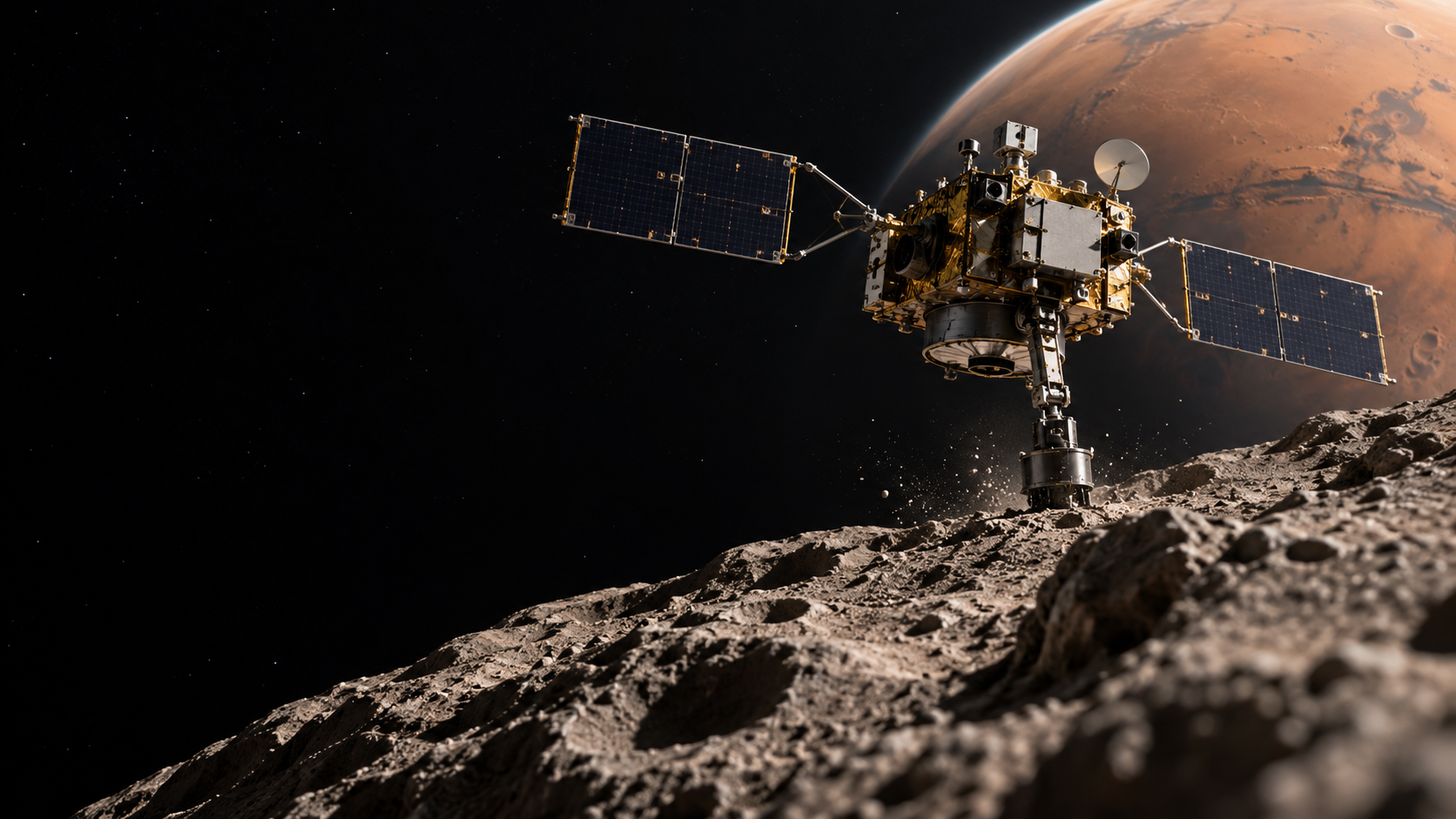
Surface Contact and Sample Collection
Sampling a small moon is a precision operation. Phobos’s weak gravity means that contact dynamics can differ substantially from those experienced during a conventional planetary landing. A spacecraft may bounce, shift, or disturb surface material more easily than expected.
Dust and loose regolith could affect sensors, mechanisms, and seals. Uneven terrain could make it difficult to maintain a stable position. Rocks, crater rims, and slopes could limit access to scientifically attractive areas.
At a high level, the spacecraft must:
- Reach a selected sampling region.
- Approach or contact the surface under controlled conditions.
- Acquire surface or near-surface material.
- Verify that collection occurred.
- Seal and document the sample.
The supplied sources do not confirm the sample mass, number of collection attempts, drilling depth, or collection mechanism.
Returning the Samples to Earth
After collection, the mission must preserve the sample and begin the return phase. The spacecraft must depart the Mars system, follow a carefully calculated trajectory, and release a return capsule at the appropriate time.
The capsule must protect the material during atmospheric entry, deceleration, landing, and recovery. Mission teams must then transport it to a controlled laboratory for inspection and curation.
Sample return is not a same-day result. Even a successful launch begins a project that could continue for years before the material reaches Earth.
Why the Mission Matters to Mars Science
Phobos may preserve evidence from the moon itself, Mars, and the space environment around the Red Planet. A returned sample could help researchers investigate:
- The composition and mineralogy of Phobos.
- The moon’s origin.
- The history of impacts around Mars.
- The movement of Martian material into space.
- The effects of solar radiation and micrometeorite exposure.
- The geological history of the early Mars system.
Earth-based laboratories provide capabilities that cannot fit aboard a spacecraft. Researchers can use larger instruments, repeat measurements, compare results across facilities, and preserve portions of the sample for future techniques.
The mission will not guarantee one definitive answer. Planetary science advances through several lines of evidence, and a Phobos sample would become one important part of that larger investigation.
Questions Scientists Hope to Answer
Researchers want to know:
- Is Phobos primarily made from material originating on Mars?
- Does its composition resemble asteroids more closely than Mars?
- Could debris from major Martian impacts have accumulated to form the moon?
- How old are the collected materials?
- What does the sample reveal about Mars’s geological and environmental history?
- How have radiation and micrometeorite impacts altered the surface?
- Does material beneath the weathered surface differ from exposed dust and rocks?
The answers may depend on whether the spacecraft collects native Phobos material, material derived from Mars, or a mixture of sources.
Major Mission Challenges
A sample-return mission is a chain of difficult operations. A failure during launch, cruise, sampling, return, or recovery could prevent the mission from delivering material to Earth.
Launch and Early Operations
Early risks include liftoff, stage separation, spacecraft deployment, communications, attitude control, power activation, and the transition from launch configuration to deep-space operations.
Live status information should come from official mission control, JAXA, the launch provider, or reputable reporting that cites those sources.
Navigation Around Mars and Phobos
The spacecraft must manage Mars’s gravitational influence while approaching a much smaller moon. Small navigation errors can become significant during close approaches.
Mission teams require accurate tracking, reliable observations, and precisely timed maneuvers. Communication delays mean that controllers cannot respond instantly to every event.
Surface Contact and Sample Integrity
Contact with Phobos requires careful control. The sampling hardware must function in an unfamiliar environment while avoiding contamination.
Earth material must not compromise the scientific value of the Phobos sample. The returned material must also be handled according to applicable planetary-protection and containment procedures. Specific protocols should come from official mission documents rather than inference.
Reentry and Recovery
The return capsule must survive high-speed atmospheric entry, heating, deceleration, and landing or recovery operations. The sample must remain secure during transport to a controlled facility.
The mission is not fully successful when the capsule reaches Earth. The material must be safely recovered, verified, and preserved.
How to Watch the Launch
Yahoo Tech is reported to be providing live launch coverage. Source 3
Readers should also check JAXA’s official website and the launch provider’s channels for an official broadcast, countdown updates, and delay notices. The supplied sources do not include a verified direct livestream URL.
Before watching:
- Confirm the launch time and time zone.
- Check for weather or technical delays.
- Use official updates for schedule changes.
- Follow the countdown, liftoff, separation, and initial spacecraft contact.
- Distinguish launch success from mission success.
Key broadcast events may include final launch checks, countdown, liftoff, ascent, stage separation, spacecraft deployment, initial communication with mission control, and confirmation of the planned early trajectory.
The most dramatic images will occur during launch. The most important scientific milestones may come much later, during Phobos observations, sampling, return, recovery, and laboratory analysis.
What Happens After Launch?
The first post-launch phase focuses on spacecraft health. Controllers will assess power generation, communications, attitude control, navigation, thermal conditions, and payload status.
Later milestones may include trajectory-correction maneuvers, arrival in the Mars system, Phobos observations, surface sampling, departure from the Mars system, Earth approach, atmospheric entry, and sample recovery.
No sample results will be available on launch day. After recovery, researchers must inspect the material, verify its condition, prevent contamination, and conduct detailed analyses. Initial findings may emerge after laboratory work begins, while broader conclusions could take much longer.
What the Mission Means for Japan’s Space Program
The mission represents advanced robotic exploration and sample-return capability. It requires deep-space communications, autonomous spacecraft operations, navigation near small bodies, precision surface contact, sample containment, and long-term mission management.
The project could build experience in:
- Deep-space communications.
- Autonomous spacecraft operations.
- Navigation near small bodies.
- Precision landing or surface contact.
- Contamination-controlled sample handling.
- International planetary science collaboration.
Details about project leadership, instruments, partner agencies, and mission architecture should come from official JAXA documentation.
Key Facts
- Mission objective: Collect samples from Phobos and return them to Earth.
- Destination: Phobos, a moon of Mars.
- Reported launch date: October 19, 2026. Source 1
- Coverage: Yahoo Tech is reported to offer live launch coverage.
- Scientific focus: Phobos’s composition, origin, and relationship to Mars.
- Immediate expectation: Launch and spacecraft deployment, not sample return.
- Unverified details: Launch time, rocket, launch site, mission duration, sampling location, and official broadcast link.
FAQ
What is Japan launching to Phobos?
Japan is launching a robotic mission designed to study Phobos, collect surface material, and return the samples to Earth for laboratory analysis.
When is the mission scheduled to launch?
The supplied source summaries identify October 19, 2026, as the scheduled launch date. The exact launch time and any delay information should be confirmed through JAXA or the launch provider.
Why does Japan want samples from Phobos?
Phobos samples could reveal the moon’s composition and origin. They may also contain material linked to Mars, helping scientists study the history of the Mars system and the early Solar System.
Can people watch the launch live?
The supplied reports state that Yahoo Tech is providing live coverage. Readers should also check JAXA’s official channels for a confirmed livestream or mission page.
How long will it take to bring the samples back?
The supplied sources do not state the mission timeline. Sample return requires launch, interplanetary travel, Phobos operations, departure from the Mars system, the return journey, reentry, and recovery.
Will scientists know immediately what the samples contain?
No. Researchers must transport the material to controlled laboratories, verify its condition, and conduct chemical, mineralogical, isotopic, and microscopic analyses. Results will develop over time rather than during the launch broadcast.
A Launch With a Much Longer Story Ahead
Japan is preparing to launch a mission targeting Phobos on October 19, 2026. Its larger objective is to bring material from a Martian moon back to Earth, where scientists can examine it with instruments far more powerful and flexible than those carried by a spacecraft.
Liftoff is the beginning, not the conclusion. The mission must survive interplanetary travel, operate near Mars, approach a small and irregular moon, collect a useful sample, return safely, and complete a controlled recovery.
The most important discoveries may come years after launch, when researchers begin analyzing material that has never before been examined in an Earth laboratory. Follow verified Yahoo Tech, JAXA, and launch-provider updates for the confirmed schedule and mission status.
Artikel Terkait
-
 SpaceX Launch Rescheduled: Could a Space Jellyfish Appear?
-
 Could Earth’s Core Be Leaking Ancient Material?
-
 Ancient DNA Reframes When Humans Reached North America
-
 Japan’s MMX Mission Will Return a Phobos Sample
-
 SpaceX Launch Could Create a Space Jellyfish
-
 Orionid Meteor Shower 2026: When and How to Watch