Japan’s MMX Mission: Returning Samples from Phobos
Japan’s MMX Mission: Returning Samples from Phobos
Japan’s Martian Moons eXploration (MMX) mission is designed to investigate Mars’ two small moons, Phobos and Deimos. Its central objective is ambitious: collect material from Phobos and return it to Earth for detailed laboratory analysis.
The mission addresses a major question in planetary science: are Mars’ moons captured asteroids, or did they form from debris thrown into orbit after a massive impact on Mars? Their small sizes, irregular shapes, and unusual orbits have supported both explanations for decades.
MMX will study more than Phobos’ surface. It will examine the wider Martian system, including Mars, Phobos, and Deimos, while investigating how material moves between them. Orbital observations, surface operations, sample collection, and the return journey are designed to work together.
A returned sample could reveal Phobos’ composition and history in far greater detail than remote sensing alone. It might also contain material blasted from Mars by ancient impacts, creating an indirect geological record of the Red Planet.
What Is Japan’s MMX Mission?
The mission’s main objective
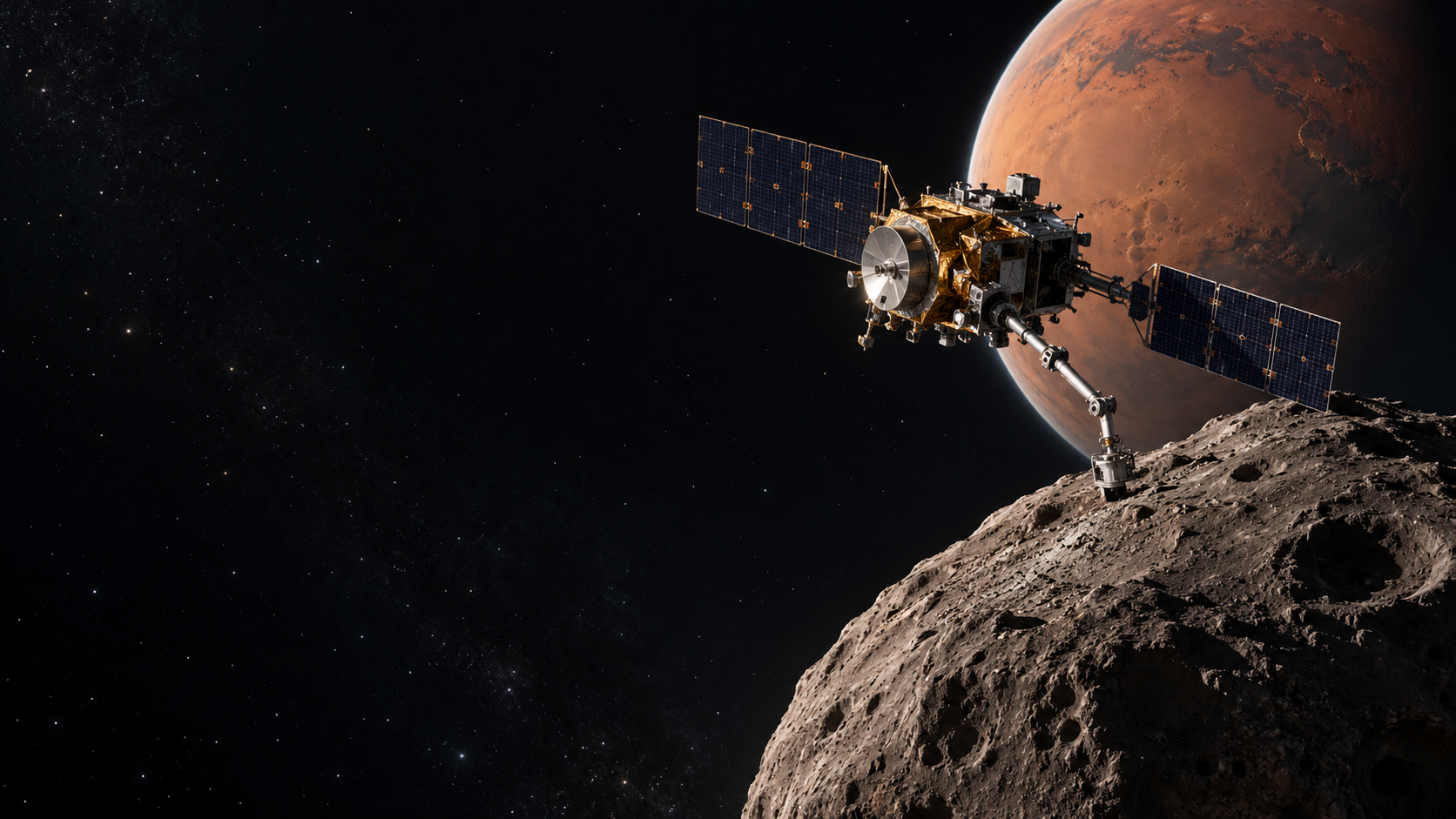
Led by the Japan Aerospace Exploration Agency (JAXA), MMX will combine orbital observation, close surface investigation, sample acquisition, and delivery of the collected material to Earth. Phobos is the primary sampling target.
This combination distinguishes MMX from a conventional planetary orbiter. An orbiter can map a moon’s surface and measure its chemical properties remotely, while a sample-return mission can place individual grains, minerals, and fragments under powerful laboratory instruments on Earth.
Orbital data will help identify geological regions, map mineral variations, and locate a suitable sampling area. Surface measurements will document the terrain. Scientists can then connect laboratory results to a specific geological context.
Japan’s experience with the Hayabusa and Hayabusa2 asteroid sample-return missions provides an important technical foundation. Those missions demonstrated the challenges of operating around low-gravity bodies, including spacecraft contact, dust movement, and departure dynamics.
JAXA describes MMX as a mission intended to clarify the origin and evolution of the Martian moons while studying the exchange of material within the Mars system. JAXA mission information
The broader Martian system
Mars, Phobos, and Deimos form an interconnected environment. Asteroid impacts on Mars can eject rocks and dust into space, and some of that material may reach the moons. Impacts on Phobos can likewise redistribute material across its surface and into space.
Studying Phobos could therefore reveal more than the moon’s own composition. Its regolith may preserve traces of Mars’ impact history, ancient planetary materials, and the small bodies that passed through the inner Solar System.
Why Phobos Is the Scientific Target
A small moon with major unanswered questions
Phobos is the larger and closer of Mars’ two moons. It is an irregular body approximately 27 kilometers across at its widest point and orbits Mars at a very close distance compared with most planetary moons.
Its origin remains unresolved. One leading hypothesis proposes that Phobos is a captured asteroid. Another suggests that it formed from debris produced by a major impact on Mars. Material blasted from the planet may have entered orbit, gradually assembled into one or more moons, and later evolved through collisions and gravitational interactions.
Neither explanation fully accounts for every observation. Phobos has properties that resemble primitive asteroids, but its orbit and relationship with Mars have also encouraged impact-origin models. Its composition, mineral structure, isotopic signatures, and surface material could help distinguish between the alternatives.
What makes Phobos different from Mars?
Phobos has extremely weak gravity and an irregular shape. Its surface may contain material from several sources:
- Rocks and dust produced within Phobos.
- Fragments ejected from Mars by impacts.
- Material delivered by asteroids and other impactors.
- Debris redistributed by impacts on the moon.
Its loose surface layer, called regolith, may therefore contain a mixed record of the Martian environment. Fine dust may have been exposed to solar radiation, micrometeorite impacts, and the space environment for long periods.
Space weathering can alter minerals and darken or chemically modify surface grains. Researchers will need to distinguish Phobos’ original composition from changes caused by exposure to space.
Why Deimos still matters
Deimos is smaller and farther from Mars than Phobos, but it remains important to the mission’s broader scientific context. Comparing the two moons may reveal whether they share a common origin.
Similar compositions could support a shared formation process. Significant differences could indicate separate histories, such as the capture of unrelated asteroids or the formation of one moon from Martian debris and the other from an external body.
How MMX Will Study the Martian Moons
Remote sensing from orbit
Before surface operations, MMX will use orbital observations to examine Phobos and the surrounding Mars system. Its instruments will investigate mineral composition, surface geology, crater distributions, thermal behavior, and possible carbon-bearing materials.
Orbital mapping will help scientists identify regions that are both scientifically valuable and operationally manageable. A site with unusual mineral signatures may offer important evidence about Phobos’ origin, but steep slopes, large boulders, loose dust, or uncertain terrain could make it unsafe for contact.
The spacecraft will also search for signs of material transported from Mars. Researchers can compare Phobos’ surface composition with Martian materials observed by orbiters, landers, and rovers.
Navigating a low-gravity environment
Phobos presents flight challenges unlike those encountered around Earth, Mars, or larger moons. Its gravity is so weak that a spacecraft approaching the surface cannot rely on normal landing dynamics.
A small change in velocity can significantly alter the spacecraft’s trajectory. Contact may cause bouncing, sliding, or unexpected rotation. Dust and loose regolith can also behave differently from material on a larger body.
MMX will operate within Mars’ gravitational influence while navigating around Phobos and accounting for the moon’s orbital motion. Autonomous guidance and precise navigation will therefore be essential, especially because communication delays prevent mission controllers from responding instantly to every surface event.
Surface operations and sampling
The sampling sequence is expected to involve several carefully controlled steps:
- Identify and approach a selected site.
- Conduct close-range surface observations.
- Make controlled contact with the terrain.
- Collect regolith or near-surface material.
- Secure the material inside a containment system.
The sample’s scientific value depends on preserving its condition and documenting its location. A grain collected from a known geological setting can be interpreted more confidently than an isolated fragment with no context.
Sampling hardware must work under uncertain conditions. The surface could contain loose dust, compacted regolith, exposed rock, or abrasive particles. The spacecraft must collect enough material while limiting the risk of destabilization or sample loss.
Returning the sample to Earth
After sampling, MMX must depart Phobos and remain on a controlled trajectory through the Mars system. It will then begin the journey to Earth, where a sample capsule will be recovered and transferred to specialized laboratories.
The return phase requires successful departure, accurate navigation, sample protection during interplanetary travel, atmospheric entry, and recovery operations. Launch and return schedules may change during development, so current details should be checked against JAXA documentation.
What Scientists Hope to Discover
Determining Phobos’ origin
Laboratory analysis could test the captured-asteroid and impact-debris hypotheses through several lines of evidence:
- Mineral composition.
- Elemental abundances.
- Isotopic ratios.
- Water-related alteration.
- Organic and carbon-bearing compounds.
- Similarities to known asteroid classes.
- Evidence of Mars-derived material.
Isotopes can act as fingerprints of formation environments. If Phobos samples share distinctive isotopic characteristics with Martian rocks, an impact origin becomes more plausible. If they resemble primitive asteroid material, a capture scenario may gain support.
No single measurement is likely to settle the question. Scientists will compare chemistry, mineralogy, isotopes, textures, and geological context.
Investigating links between Phobos and Mars
Impacts on Mars can throw rocks and dust above the planet’s surface. Some ejecta may enter trajectories that intersect Phobos. Over geological time, this process could deposit Martian material on the moon.
A returned sample might contain fragments of Martian rock or dust mixed with native Phobos regolith. Identifying such material would provide a new way to study Mars and could complement rover investigations.
Phobos may contain material sourced from a much wider region of Mars than any single rover can explore.
Understanding the early Solar System
Phobos could preserve evidence about the formation of rocky worlds and the movement of small bodies through the inner Solar System. Its material may record the delivery of water-bearing or carbon-rich compounds, ancient impacts, and chemical conditions present during planetary formation.
Phobos is not an untouched relic. Impacts, radiation, solar-wind exposure, and surface mixing may have altered its outer layers. The scientific challenge is to identify which features are ancient and which developed later.
Searching for carbon-bearing and organic material
Scientists may search Phobos samples for carbon-bearing compounds and organic molecules. Finding organic material would not prove that life existed on Mars or Phobos. Organic chemistry can arise through biological and nonbiological processes.
Researchers would examine the compounds’ structures, distributions, isotopic compositions, mineral associations, and formation histories. These measurements could indicate whether the material is native to Phobos, delivered by impacts, or connected to Mars.
Why Sample Return Matters
Earth laboratories provide greater analytical power
Spacecraft instruments must operate within strict limits on mass, power, size, and durability. Earth laboratories can use larger and more sensitive equipment, including instruments that cannot be flown on a robotic spacecraft.
Researchers can examine individual grains, measure precise isotope ratios, study mineral structures at microscopic scales, and repeat analyses with improved techniques. Samples can also be divided among laboratories for independent verification.
A returned sample remains available as technology advances and new scientific questions emerge.
Context increases scientific value
Laboratory results become more meaningful when connected to the sampling site. Scientists can combine chemical measurements with orbital maps, surface images, local geology, crater counts, thermal observations, and measurements of Mars and Deimos.
Contamination control
Sample-return missions must protect both the sample and Earth-based facilities. Terrestrial material entering the container could obscure the sample’s original chemistry. Returned extraterrestrial material must therefore be handled under carefully controlled procedures.
Strict containment, documentation, contamination monitoring, and appropriate sterilization protocols help preserve credible scientific results.
The Engineering Risks
MMX must travel across interplanetary distances while navigating a changing gravitational environment. Communication delays limit real-time control, requiring mission teams to prepare spacecraft responses for events that may unfold before instructions arrive.
Phobos may contain loose, abrasive, or unexpectedly hard material. Its low gravity makes contact dynamics difficult to predict. The sampling mechanism must gather material without damaging the spacecraft, destabilizing the vehicle, or losing the sample.
The mission consists of linked stages: reaching Mars, surveying Phobos, making surface contact, collecting material, storing it securely, departing the moon, navigating back to Earth, and recovering the capsule. Failure at any stage could prevent sample return.
MMX in the History of Planetary Exploration
Planetary exploration has progressed from flybys to orbiters, landers, rovers, and sample-return missions. MMX combines several of these modes within one Mars-system mission.
Japan’s Hayabusa and Hayabusa2 missions showed how spacecraft can approach small bodies, operate under weak gravity, collect material, and return it to Earth. MMX extends that capability to a more complex setting: a moon influenced by both its own surface environment and Mars’ gravitational and geological history.
The technologies developed for MMX could support future operations around asteroids, small moons, Mars, and other low-gravity bodies.
What Could Change After the Samples Arrive?
MMX could revise current theories about Phobos’ formation. The returned material may support an asteroid origin, favor formation from Martian impact debris, or reveal a more complex history involving multiple sources.
The findings could influence models of Mars’ early evolution, planetary impact rates, and the delivery of water-bearing or carbon-rich materials to the inner Solar System.
If Phobos contains identifiable Martian fragments, scientists may gain access to material from regions that no rover has visited. The greatest impact will likely come from combining MMX results with Mars orbiter observations, rover measurements, meteorite studies, and future sample-return missions.
Conclusion
The MMX mission aims to return the first samples from a Martian moon for laboratory study. Phobos matters because its material may preserve evidence about both the moon itself and Mars.
The mission will investigate Phobos’ origin, the materials that reach it from Mars, and what its composition reveals about the early Solar System. Its orbital observations and surface operations will provide the context needed to interpret the returned material.
If successful, MMX could transform Phobos from a distant, mysterious object into a physical archive of Mars’ history.
Frequently Asked Questions
What is Japan’s MMX mission?
MMX stands for Martian Moons eXploration. It is Japan’s planned mission to study Mars’ moons, particularly Phobos, and return collected material to Earth for scientific analysis.
Why is MMX targeting Phobos?
Phobos may preserve clues about the origin of Mars’ moons and the history of the Martian system. Its surface could also contain material blasted from Mars by ancient impacts.
Is Phobos an asteroid captured by Mars?
Scientists have not definitively resolved Phobos’ origin. The leading explanations include the capture of an asteroid and formation from debris produced by a major impact on Mars.
What could Phobos samples reveal about Mars?
The samples may contain material transferred from Mars. Laboratory analysis could provide information about Martian minerals, impact history, water-related alteration, and carbon-bearing compounds.
Why return samples to Earth instead of analyzing them in space?
Earth laboratories offer larger and more capable instruments than spacecraft can carry. Scientists can preserve, reanalyze, and distribute the samples as analytical techniques improve.
Would organic material on Phobos prove that life existed?
No. Organic compounds can form through biological and nonbiological processes. Their discovery would require detailed chemical, geological, and isotopic analysis to determine their origin.