Francis Halzen and the Search for Cosmic Neutrinos
Francis Halzen and the Search for Cosmic Neutrinos
Reports claiming that physicist Francis Halzen won the Nobel Prize in Physics for neutrino research have drawn attention to one of modern science’s most ambitious experiments: detecting elusive particles in the ice beneath the South Pole.
The reports describe neutrinos as “ghost particles” because they rarely interact with matter. Vast numbers pass through Earth, buildings, detectors, and human bodies without leaving a trace. Halzen’s work helped advance the experimental methods needed to detect some of the highest-energy neutrinos ever observed and use them to investigate violent events across the universe.
However, the supplied reports do not include an official Nobel citation, announcement date, prize-sharing details, or a direct statement from NobelPrize.org. The claim should therefore remain described as reported or unverified until confirmed by the official Nobel source. Reports from Astronomy.com and the Associated Press identify Halzen as the alleged 2026 physics laureate, but the supplied links provide limited supporting detail (Source 3; Source 9).
Regardless of the award claim’s status, the science is significant. Antarctic neutrino research has created a new way to study cosmic events—not through light alone, but through particles that can cross enormous distances and dense environments.
Who Is Francis Halzen?
Francis Halzen is a physicist associated with experimental neutrino research and the development of large-scale neutrino observatories. He is widely linked to the IceCube Neutrino Observatory, an international project that uses Antarctic ice to detect high-energy neutrinos.
The achievement is not the discovery of neutrinos themselves. Neutrinos were proposed in the early twentieth century and later detected through experiments designed to observe their rare interactions with matter. Halzen’s contribution belongs to a later stage of neutrino science: developing the technology and research program needed to detect extremely high-energy neutrinos from outside the Solar System.
That work required more than sensitive instruments. Researchers needed a detector large enough to capture rare interactions, techniques for separating genuine signals from background noise, and analytical tools capable of reconstructing a particle’s direction and energy.
What Are “Ghost Particles”?
Neutrinos are electrically neutral subatomic particles with very small masses. Because they carry no electric charge, magnetic fields do not bend their paths as they do those of charged particles. Neutrinos also interact through the weak nuclear force rather than the stronger electromagnetic force.
These properties make neutrinos difficult to detect. A neutrino can pass through a large amount of matter without being absorbed or deflected. Trillions pass through every person each second, mostly without interacting with atoms in the body.
“Ghost particle” is a media nickname, not a formal scientific classification. It describes how neutrinos move through matter almost unnoticed. They are not completely invisible: under rare conditions, a neutrino collides with an atomic particle and produces detectable secondary particles.
Those collisions form the basis of neutrino detection.
How Neutrinos Are Detected
A detector does not usually observe a neutrino directly. Instead, it records the products of a neutrino interaction.
When a neutrino collides with a particle in matter, the event can create a charged secondary particle. If that particle moves faster than light travels through the surrounding material, it emits a faint blue flash called Cherenkov light. Sensitive optical sensors record the timing and pattern of that light.
Most neutrinos pass through a detector without interacting. Researchers therefore need enormous detection volumes, highly sensitive sensors, advanced data processing, and statistical methods that distinguish meaningful events from background activity.
Potential background sources include cosmic rays, atmospheric neutrinos, detector noise, and natural effects within the detection medium.
How IceCube Works
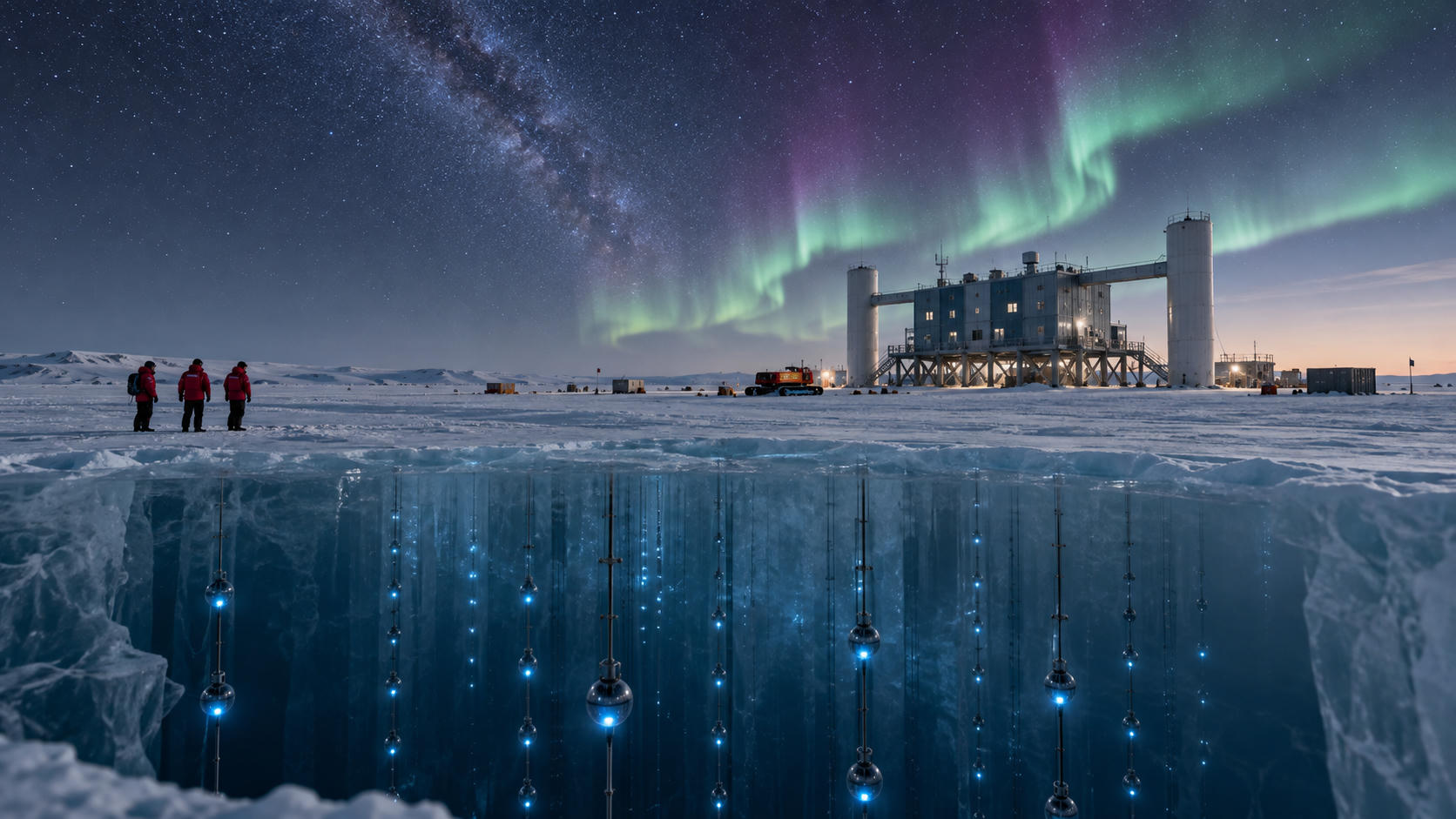
The IceCube Neutrino Observatory is embedded deep in the ice at the South Pole. Its sensors are arranged on strings lowered into drilled holes beneath the surface. The surrounding ice provides the material in which neutrino interactions can occur.
The detection process generally follows these stages:
- A neutrino enters the Antarctic ice.
- It occasionally collides with an atomic particle.
- The collision creates a charged secondary particle.
- The secondary particle produces Cherenkov light as it travels through the ice.
- Optical sensors detect the light.
- Researchers analyze the timing and distribution of the signals.
- Computer models reconstruct the event’s direction and energy.
Some events produce long tracks, allowing scientists to estimate a particle’s direction with relatively high precision. Other events create more localized patterns. Researchers compare each event with simulations and background estimates.
Antarctic ice offers a vast, stable, and relatively clear detection medium. Its remote location also reduces some forms of human-generated interference. The environment is difficult to work in, but the ice makes it possible to build a detector on a scale that would be expensive to achieve with conventional equipment.
Why Antarctica Matters
The South Pole presents severe logistical challenges. Equipment must operate in extreme cold, and personnel face long periods of limited access. Drilling, deploying sensor strings, maintaining electronics, and transmitting data require careful planning.
The remoteness is also an advantage. A low-noise environment helps scientists identify faint signals. Deep ice provides shielding from some unwanted particles and creates a large target volume for neutrino interactions.
The observatory turns a natural environment into a scientific instrument. Instead of constructing a massive tank or chamber from manufactured materials, researchers use the Antarctic ice itself as part of the detector.
Neutrinos as Cosmic Messengers
Traditional astronomy relies primarily on electromagnetic radiation, including visible light, radio waves, X-rays, and gamma rays. Neutrinos provide a different source of information.
Because they interact so weakly, neutrinos can escape regions that trap or scatter light. They can also travel across space without being strongly deflected by magnetic fields. Their paths may therefore point toward the environments that produced them.
High-energy neutrinos may originate in powerful processes such as:
- Supernova explosions
- Active galactic nuclei
- Black-hole environments
- Collisions involving cosmic rays
- Other extreme astrophysical events
Detecting a neutrino does not automatically identify its source. Researchers must estimate its direction, compare it with astronomical observations, evaluate its energy, and determine whether the association is statistically meaningful.
When a neutrino event is linked with observations from telescopes or other observatories, scientists gain a more complete picture of the underlying cosmic process.
From Particle Physics to Astronomy
Neutrino research connects particle physics and astrophysics. Particle physics examines fundamental particles and their interactions, while astrophysics investigates stars, galaxies, black holes, explosions, and the structure of the universe.
An Antarctic neutrino observatory contributes to both fields. It measures particle interactions at energies that may be difficult to reproduce in laboratories while searching for evidence of distant cosmic accelerators.
This work has helped advance multimessenger astronomy, which studies astronomical events through multiple forms of information, including light, neutrinos, cosmic rays, and gravitational waves.
Each messenger reveals different features. Light can show temperature, chemical composition, and visible structure. Gravitational waves can reveal the motion of massive objects. Neutrinos can carry information from dense or energetic regions that electromagnetic radiation may not escape.
Why the Reported Nobel Recognition Would Matter
If the Nobel claim is confirmed, the recognition would reflect more than the detection of individual particles. It would acknowledge a new observational method.
The achievements associated with Halzen’s research include:
- Developing large-scale methods for detecting high-energy neutrinos
- Using Antarctic ice as a particle detector
- Establishing neutrino astronomy as a practical field
- Connecting rare particle events with cosmic phenomena
Scientific instruments change what researchers can observe. Telescopes expanded astronomy beyond unaided vision, and radio telescopes revealed objects invisible in ordinary light. Neutrino observatories add another channel for studying the universe.
The exact significance of any Nobel award depends on the official citation. Until NobelPrize.org publishes or confirms the relevant information, descriptions of the prize’s wording, recipients, and scientific scope should remain provisional.
Challenges in Neutrino Detection
Separating Signals from Background Noise
A neutrino detector records many types of events. Cosmic-ray particles can produce signals resembling neutrino interactions. Atmospheric neutrinos are another important background, while electronics and optical sensors can introduce additional noise.
Scientists evaluate events by examining their direction, energy, timing, shape, position within the detector, and compatibility with expected background rates. Reliable conclusions come from statistical analysis across many events, not from one unexplained flash.
Operating at the South Pole
Teams must drill deep holes, lower sensor strings into the ice, maintain communications, and operate equipment under harsh conditions. The detector must function for long periods with limited access. A component that fails during the Antarctic winter may not be repairable until the next operational season.
Interpreting Rare Cosmic Events
High-energy neutrinos are uncommon. A promising event must be compared with physical models and independent observations. Confidence increases when researchers identify repeated events from a similar direction, observe compatible energies, or find corresponding activity in electromagnetic or gravitational-wave data.
These safeguards help prevent scientists from treating every unusual signal as evidence of a new cosmic source.
The Future of Neutrino Astronomy
Future progress will depend on larger detection volumes, more sensitive sensors, improved event reconstruction, and faster communication among observatories.
Expanded Antarctic instrumentation could increase the number of detected events and improve scientists’ ability to identify their sources. Better analysis methods may also distinguish neutrino types and energy ranges more effectively.
Multimessenger astronomy will remain central. Neutrino data can be combined with visible light, radio waves, X-rays, gamma rays, gravitational waves, and cosmic-ray measurements.
Together, these observations can reveal how particles are accelerated, how black holes consume matter, and how explosive events develop. Neutrino research may also address why neutrinos have mass, whether neutrinos and antineutrinos behave differently, how particles interact at extreme energies, and what mechanisms generate cosmic rays.
These remain open research questions and should not be presented as solved by any single observatory or award.
Frequently Asked Questions
What did Francis Halzen reportedly win the Nobel Prize in Physics for?
The supplied reports say Halzen was recognized for research involving neutrinos detected using Antarctic ice. The official Nobel citation, award year, prize-sharing details, and announcement should be confirmed through NobelPrize.org before publication.
What are neutrinos?
Neutrinos are electrically neutral subatomic particles with very small masses. They interact weakly with matter, allowing many to pass through Earth and other materials without being absorbed or deflected.
Why are neutrinos called “ghost particles”?
The nickname refers to how rarely neutrinos interact with matter. Most pass through detectors unnoticed, although occasional collisions create secondary particles and detectable light.
How are neutrinos detected in Antarctic ice?
Sensors embedded deep in the ice search for Cherenkov light produced when a neutrino interaction creates a charged particle that travels through the ice.
Why is Antarctic ice useful?
The ice offers a large, stable, and relatively clear detection medium. The South Pole’s remote location also limits some forms of human-generated interference.
Why are neutrinos important for astronomy?
Neutrinos can travel through dense environments and across cosmic distances without being strongly deflected. Their detection helps researchers investigate energetic objects and events that light alone may not fully reveal.
Conclusion
The reported Francis Halzen Nobel Prize in Physics recognition centers on one of modern science’s most difficult tasks: detecting neutrinos, particles that usually pass through matter without leaving a trace.
By using the deep ice beneath the South Pole as a giant detector, researchers can identify rare neutrino interactions, estimate their energies and directions, and search for the cosmic events that produced them. The result is a new form of astronomy that complements observations made with light, gravitational waves, and cosmic rays.
The award claim remains subject to official verification. Before publication, editors should confirm the Nobel year, official citation, prize-sharing details, and detector-specific facts through NobelPrize.org and authoritative IceCube or institutional sources.
Artikel Terkait
-
 Northern Lights May Be Visible Across the U.S. This Weekend
-
 Why Deep-Sea Rocks Caught Fire in a Laboratory
-
 165-Million-Year-Old Fossil Reveals Broad Swimming Tail
-
 Northern Lights Possible Tonight as Storm Strengthens
-
 IceCube and the Truth About Neutrino “Ghost Particles”
-
 Ancient Radio Burst May Set Distance Record