AP Top 25: Miami No. 1 as BYU Surges to No. 2
AP Top 25: Miami Takes No. 1 as BYU Surges to No. 2
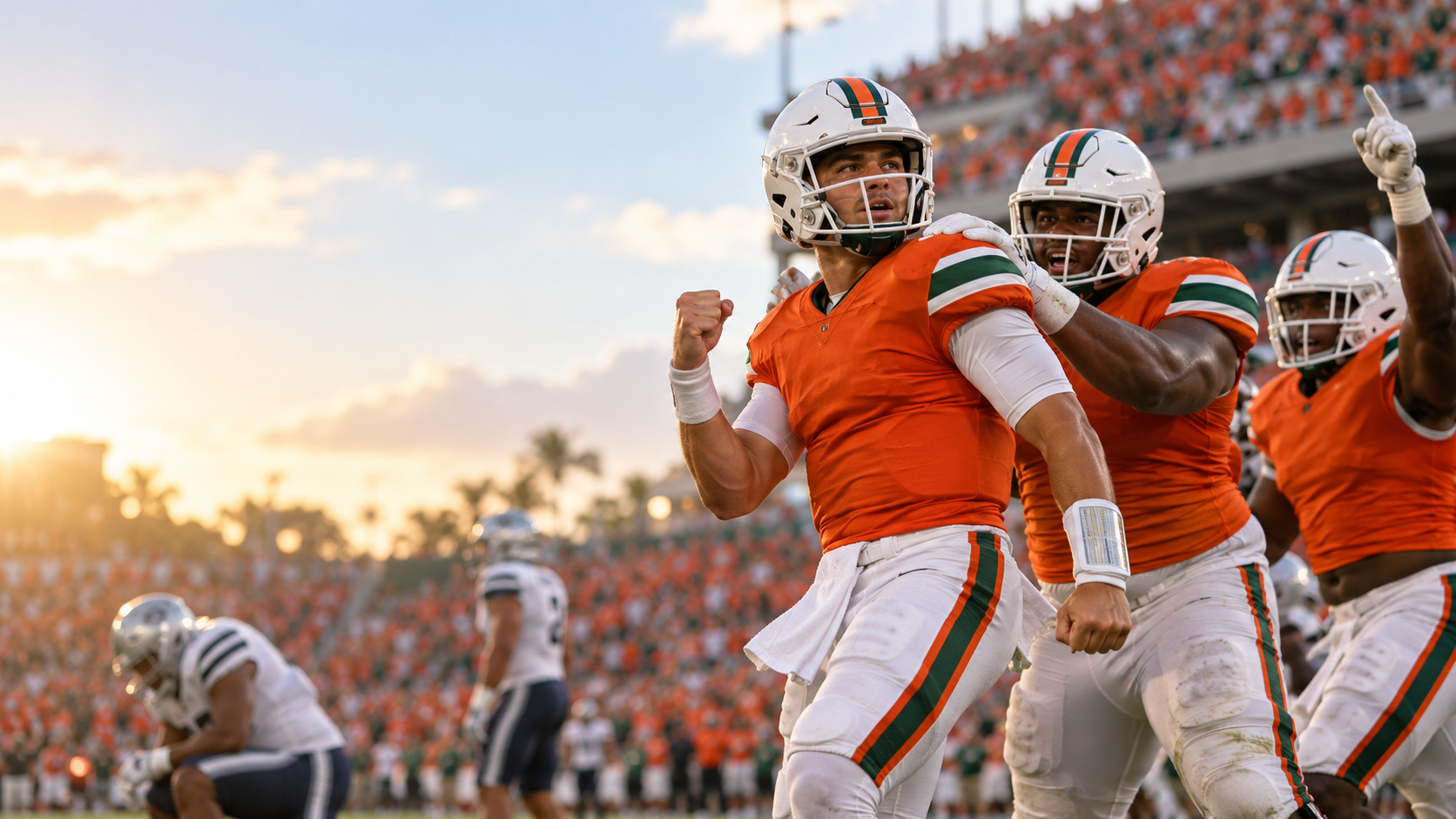
The latest AP Top 25 poll has a new team at the top. Miami moved to No. 1, while BYU surged to No. 2 after a chaotic week in which five teams ranked inside the top seven lost. The results produced major movement across the college football rankings and changed the national championship conversation.
Miami’s promotion reflects both the Hurricanes’ position in the national title race and the instability among the teams previously ranked above them. BYU’s rise is equally significant because it places the Cougars directly behind Miami and among the leading championship contenders.
The reshuffling also affected Texas, Alabama, Missouri, Pitt and Indiana. Texas and Alabama suffered major ranking declines, Missouri made a significant rise, and Pitt entered the poll. One reported update also placed Alabama ahead of Indiana. The available reports confirm these developments but do not provide enough information to present a complete, verified ranking table.
One source identifies the movement as the Week 8 rankings and gives a publication date of October 18, 2026. Other reports describe the latest AP poll without providing a date. This analysis therefore focuses on the reported changes rather than assigning unverified records, scores or exact positions beyond Miami at No. 1 and BYU at No. 2.
Miami Takes Over the No. 1 Ranking
Miami’s move to No. 1 is the central result of the latest AP Top 25 poll. The Hurricanes benefited from losses by several teams near the top of the rankings and gained enough support from voters to claim the highest position.
A midseason No. 1 ranking carries a different meaning from a strong preseason projection. A preseason ranking reflects expected ability, while a midseason promotion reflects what voters have seen, how the team compares with current contenders and how the wider championship picture has changed.
Miami’s new ranking indicates that voters view the Hurricanes as the strongest team in the reported poll at this point. It also demonstrates how quickly the college football rankings can change when several leading programs lose during the same weekend.
The available reports do not provide Miami’s exact record, point total, voting margin or complete list of opponents. Those details should not be inferred from the ranking alone. The confirmed development is Miami’s rise to No. 1. Source 1
Why Voters Elevated Miami
AP voters reassess the entire top tier after major losses. A team does not need to change its own ranking case dramatically to move upward; it can benefit when teams above it weaken their positions.
Miami’s promotion likely reflects several factors:
- Recent results gave voters greater confidence.
- The Hurricanes compared favorably with teams that lost.
- The program appeared capable of competing for the national championship.
- Performance and timing created momentum in the poll.
The distinction between résumé and current form also matters. A résumé-based ranking emphasizes the quality and significance of a team’s full season. A form-based ranking asks which teams are playing the best football now. The AP poll can reflect both, but a weekend with five top-seven losses naturally places greater attention on recent results.
The available sources confirm Miami’s new position but do not include the full voting breakdown or point total. That limits how precisely the change can be measured. The ranking itself, however, signals a substantial shift in national perception. Source 3
The Pressure of Being No. 1
The No. 1 ranking creates immediate pressure. Miami is now the team opponents want to defeat, and every remaining game will receive greater national attention.
Close wins may face increased scrutiny because voters will judge them against the standards attached to the top ranking. A loss could also produce a sharp decline, especially if another contender wins convincingly during the same week.
The ranking can affect playoff projections, betting markets, recruiting visibility and opponents’ preparation. It does not guarantee a championship, a playoff berth or a place near the top of the next poll. Miami must validate the ranking through continued success. The No. 1 position is a weekly evaluation, not a postseason award.
BYU Surges to No. 2
BYU’s move to No. 2 is the other defining development in the latest poll. The Cougars benefited from the same top-seven losses that opened the path for Miami, but reaching the second position still represents a major change in how voters view the program.
No. 2 status places BYU directly inside the national championship conversation. The program is no longer part of a broad group of possible contenders. It now sits behind the No. 1 team and must be evaluated as one of the leading teams in the country.
The ranking also raises expectations. Every upcoming BYU game becomes a test of whether the team belongs among the national elite. A win can strengthen its position, while a loss can prompt an immediate debate about whether the rise reflected sustained quality or a single chaotic weekend.
The available reports do not identify BYU’s previous ranking or the number of places gained. The confirmed point is its new No. 2 position. Source 7
A No. 2 ranking changes BYU’s practical environment. Opponents can now approach the Cougars as a marquee target rather than an under-the-radar team. National broadcasts, media coverage and pregame analysis are also likely to increase.
The cost of a loss becomes higher near the top of the AP poll. A setback can remove a team from the immediate championship discussion, particularly when other contenders are winning. BYU must maintain consistency after the ranking jump. Continued winning will sustain its national credibility; an unimpressive performance could allow other teams to close the gap.
An Unexpected Top-Two Pairing
Miami and BYU occupying the top two spots creates a new national storyline. Both teams benefited from widespread movement above them, demonstrating how quickly the AP poll can change after a chaotic weekend.
The pairing does not guarantee that Miami and BYU will meet in a championship game. The AP ranking is a weekly assessment, while postseason selection depends on a broader season résumé and the eventual playoff process. The significance is immediate rather than final: Miami and BYU now lead the public conversation, but both must continue producing results to remain there.
Five Top-Seven Losses Reshaped the AP Top 25
According to the reported coverage, five teams ranked inside the top seven lost. That level of disruption forced voters to reconsider the national championship picture at once. Source 7
The losses had several effects:
- Fewer highly ranked teams remained ahead of Miami and BYU.
- Voters had to reorder the top of the poll.
- Teams outside the previous top tier gained positions.
- Defeated favorites lost the protection of their earlier rankings.
- Movement spread beyond the top two and into the middle of the poll.
The reports do not name all five defeated teams, so a complete results list cannot be confirmed from the supplied material.
One upset can produce a limited adjustment. Five losses among the top seven create a chain reaction. The AP Top 25 is a relative ranking: when one team loses, another can move up even without playing. Multiple losses can produce a new No. 1 team, a dramatic rise for a team previously outside the top three and steep declines for established contenders.
Texas and Alabama Experience Major Drops
Texas suffered a major decline in the latest poll, according to the reported coverage. Source 3
A loss affects a highly ranked team in two ways. It weakens the team’s playoff résumé and gives other contenders an opportunity to move ahead. Texas can still recover through strong performances in its remaining schedule, particularly against respected opponents. The source summary does not provide Texas’s exact new ranking, so no specific position should be assigned.
Alabama also experienced a major decline, according to the reported update. At the same time, another source reported that Alabama moved ahead of Indiana in the AP rankings. These details show that the area around Alabama changed significantly, but they do not establish the full order of the poll. Source 9
A ranking drop does not automatically remove Texas or Alabama from playoff contention. Winning future games, especially against ranked opponents, can stop a decline or begin a rebound. Results involving other contenders will also affect their paths.
Missouri Rises and Pitt Enters the Rankings
Missouri made a significant rise in the latest AP rankings, according to Source 9. A team can climb quickly when several higher-ranked programs lose and voters need to fill newly available positions. The available report does not provide Missouri’s exact ranking or the number of places gained.
Pitt entered the rankings in the reported update. Entry into the AP Top 25 gives the program national recognition and makes future results more visible. However, entering the poll is not the same as becoming a leading playoff favorite. Pitt must continue winning to turn one ranking appearance into sustained national relevance.
The confirmed developments include:
- Miami moved to No. 1.
- BYU moved to No. 2.
- Texas and Alabama dropped significantly.
- Missouri made a major rise.
- Pitt entered the rankings.
- Alabama moved ahead of Indiana in one reported update.
These developments should be treated as separate, source-supported changes rather than combined into an unverified full ranking list.
What the Rankings Mean for the Playoff Race
Miami’s No. 1 ranking changes its playoff narrative. The Hurricanes are no longer chasing recognition; they are defending it. Their next results will determine whether voters view the promotion as a temporary consequence of a chaotic weekend or evidence of sustained superiority.
BYU’s No. 2 position places the program at the center of the national title discussion. The reported results also affected national championship odds, according to Bettors Insider. Source 7
AP rankings and betting odds are related but different. The AP poll reflects media-voter opinion, while betting markets reflect expectations and wagering activity. Neither determines the final playoff field.
Texas and Alabama need to stabilize their seasons after major ranking declines. Their playoff paths depend on their own results and the performance of competing programs. Neither team should be declared eliminated solely because of a ranking drop, but both have less room for error.
AP Poll Versus Other College Football Rankings
The AP Top 25 is a weekly poll conducted through media voting. It measures national perception based on team performance, résumé, current form and comparisons with other programs.
The poll provides an influential snapshot of college football opinion, but it is not the official playoff selection process. Playoff evaluations can consider strength of schedule, quality wins, conference results, head-to-head outcomes, losses and overall consistency.
A team ranked No. 1 in the AP poll is not automatically guaranteed a playoff position. The poll reflects opinion at a particular point in the season, while postseason selection examines the complete body of work.
What to Watch in the Next AP Top 25 Poll
Whether Miami Holds No. 1
Miami’s next result will be the most immediate factor. A convincing win would support the Hurricanes’ position, while a loss could reopen the top spot if another leading contender wins.
Whether BYU Can Stay at No. 2
BYU must maintain its momentum after the surge. Another win, particularly against a strong opponent, would strengthen its case for remaining No. 2. A narrow or unimpressive result could allow competing teams to close the gap.
Whether Fallen Teams Rebound
Texas and Alabama are the primary programs to monitor after their declines. A bounce-back win could stop further movement. Indiana also deserves attention because one reported update placed Alabama ahead of it.
Whether Missouri and Pitt Continue Rising
Missouri and Pitt need sustained winning to turn this week’s movement into lasting national relevance. Their next results could shape the middle and upper sections of the poll.
Conclusion
The latest reported AP Top 25 poll has Miami at No. 1 and BYU at No. 2. The change followed a turbulent week in which five top-seven teams lost, forcing voters to reorder the national championship picture.
Texas and Alabama dropped significantly, Missouri climbed, Pitt entered the rankings, and Alabama moved ahead of Indiana in one reported update. The changes show how quickly the college football rankings can shift when several leading teams lose at once.
Miami and BYU now lead the national conversation, but neither position is secure. Continued winning must validate the rankings, strengthen their playoff résumés and support their national championship cases.
Frequently Asked Questions
Why is Miami No. 1 in the AP Top 25 poll?
Miami moved to No. 1 after five teams ranked inside the top seven lost. The available reports indicate that Miami benefited from the results and gained enough support from AP voters to claim the top spot.
Why did BYU rise to No. 2?
BYU surged to No. 2 because several teams ahead of it lost. The move places BYU among the leading national championship contenders and gives the program its highest reported position in the poll.
Which teams dropped after the latest results?
Texas and Alabama experienced major ranking declines, according to the supplied reports. The available summaries do not provide every exact position change.
Did any teams enter or rise in the AP Top 25?
Yes. Missouri made a significant rise, while Pitt entered the rankings. Another reported update placed Alabama ahead of Indiana.
Does the AP No. 1 ranking guarantee a College Football Playoff spot?
No. The AP poll reflects media opinion and does not determine the final playoff field. Selection depends on the full season résumé, including wins, losses, schedule strength, conference results and other evaluation factors.
Can Texas or Alabama recover after falling in the rankings?
Yes. A ranking drop does not automatically eliminate either team from postseason contention. Strong performances in remaining games, particularly against quality opponents, could help either program regain voter confidence.
Artikel Terkait
-
 Caleb Williams Leads Bears Past Falcons in Injury Return
-
 NFL Week 6 Takeaways and Fantasy Football Outlook
-
 Big 12 Admits Clock Error in Notre Dame-BYU Game
-
 Miami Takes No. 1 in Week 8 Coaches Poll
-
 Caleb Williams Active for Bears vs. Falcons: What It Means
-
 Week 6 NFL Schedule, Scores, and Injury Updates